
Antiplatelet Drug Comparison Tool
Personalized Antiplatelet Assessment
Select your characteristics to see which drug is best suited for you based on clinical guidelines.
Your Recommended Drug
Prasugrel
Best for patients under 75 with no stroke history and high-risk PCI.
Ticagrelor
Preferred for over 75, diabetes, or high bleeding risk.
Clopidogrel
Cost-effective option for low-risk patients without CYP2C19 issues.
Important Considerations
Always consult your doctor before changing medications. This tool provides general guidance based on clinical guidelines.
When you’ve had a heart attack or stent placed, your doctor gives you a blood thinner to keep clots from forming. But not all blood thinners are the same. Three drugs-clopidogrel, prasugrel, and ticagrelor-are the most common choices. They all block platelets from sticking together, but they do it in different ways, and that changes everything: how fast they work, how strong they are, and most importantly, what side effects you might face.
How These Drugs Work (And Why It Matters)
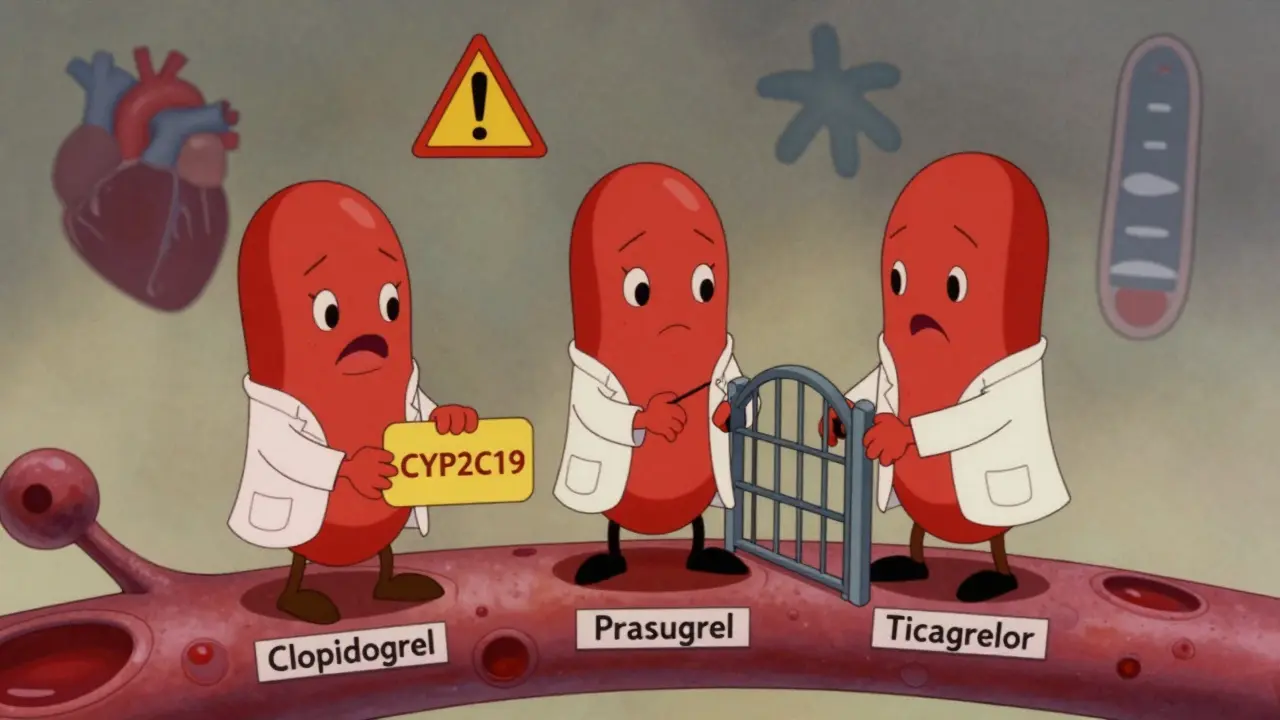
All three are P2Y12 inhibitors. That means they block a receptor on platelets that tells them to clump together. No clumping = less chance of a clot blocking an artery. But here’s the catch: they don’t all activate the same way.Clopidogrel is a prodrug. Your liver has to turn it into its active form using an enzyme called CYP2C19. About 30% of people have genetic variations that make this process slow or weak. If you’re one of them, clopidogrel might not work at all. That’s not theoretical-it’s real. Studies show these patients have a higher risk of another heart attack or stent clotting.
Prasugrel and ticagrelor don’t have this problem. Prasugrel is converted faster and more completely by the liver. Ticagrelor doesn’t need conversion at all-it’s active as soon as it hits your bloodstream. That’s why ticagrelor and prasugrel give more consistent platelet blocking, especially in people with those CYP2C19 gene variants.
The Big Risk: Bleeding
All three drugs increase your risk of bleeding. That’s the trade-off. No clotting means no heart attacks-but also no stopping a cut from bleeding too long.The TRITON-TIMI 38 trial showed prasugrel reduced heart attacks and stent clots better than clopidogrel, but it also caused more major bleeding: 2.4% vs. 1.8%. Fatal bleeding was tripled: 0.4% vs. 0.1%. That’s why prasugrel comes with a black box warning from the FDA: don’t use it if you’ve had a stroke or TIA, or if you’re over 75. It’s too risky for frail bodies.
Ticagrelor’s PLATO trial showed similar benefits over clopidogrel in preventing death from heart problems. But it also increased major bleeding slightly-2.6% vs. 2.3%. The difference seems small, but when you’re talking about millions of patients, even a 0.3% increase means thousands more bleeding events.
Clopidogrel has the lowest bleeding risk of the three, but it’s also the least reliable. If your body doesn’t activate it properly, you’re getting the bleeding risk without the protection.
Real-world data backs this up. Cardiologists on Medscape report seeing elderly patients on prasugrel drop from a hemoglobin of 12 to 8 in just days. That’s not normal-it’s dangerous. For someone with thin blood and fragile vessels, that’s a hospital trip waiting to happen.
Ticagrelor’s Unusual Side Effect: Trouble Breathing
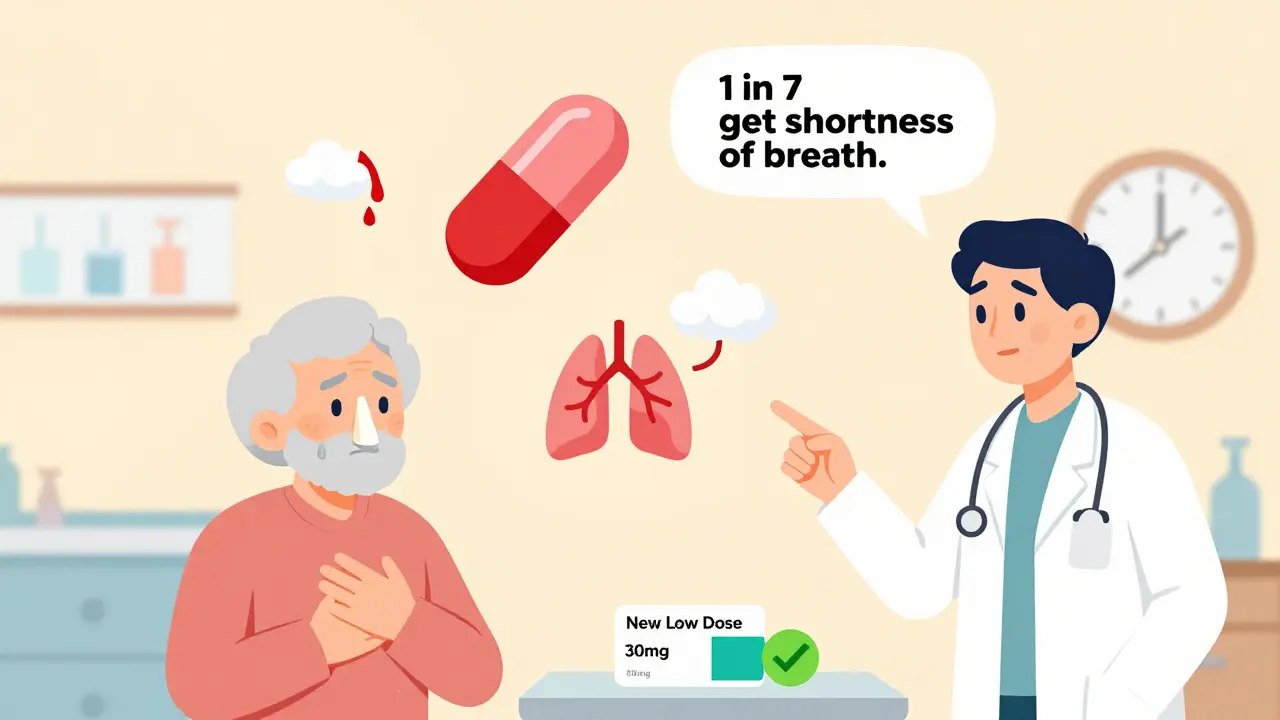
This one catches people off guard. About 1 in 7 people on ticagrelor develop shortness of breath. It’s not asthma. It’s not heart failure. It’s a direct side effect of the drug.In the PLATO trial, 14-16% of patients on ticagrelor reported dyspnea. Only 8-10% on placebo did. That’s a 69% higher chance. And it usually starts within the first week. Patients describe it as “feeling like I’m drowning,” “like I can’t get enough air,” or “like my lungs are full of cotton.”
It’s not life-threatening, but it’s terrifying. Many patients stop taking it because of it. Studies show that if you don’t warn people ahead of time, up to 20% will quit. But if you explain it-“This is a known side effect, it’s not your heart failing, and it often gets better”-60-70% stick with it.
It’s dose-dependent. The newer 30 mg dose (approved in 2023 for long-term use) cuts this side effect in half. For patients who need ongoing protection after the first year, this lower dose is becoming a go-to option.
Other Side Effects You Should Know
Ticagrelor can also cause brief pauses in your heartbeat-ventricular pauses. In trials, 3.1% of people had them, compared to 2.0% on clopidogrel. Most are harmless and don’t need treatment, but if you have a pacemaker or heart rhythm issues, your doctor needs to know.
Prasugrel’s biggest issue isn’t just bleeding-it’s how it hits people differently based on weight and age. If you weigh under 60 kg (about 132 lbs), your risk of major bleeding jumps to 2.7%. That’s why dosing isn’t one-size-fits-all. Some doctors cut the dose for smaller patients, even though it’s not officially approved.
Clopidogrel’s main problem is unpredictability. You might think it’s working because you’re not bleeding-but if your genes don’t activate it, you’re still at risk for a clot. That’s why some hospitals test for CYP2C19 variants before prescribing. But it’s expensive-$200 to $300-and guidelines don’t recommend it for everyone. It’s reserved for high-risk cases: people who had a clot while on clopidogrel, or those with strong family history of poor response.
Dosing, Timing, and Surgery
These drugs aren’t just taken differently-they’re stopped differently before surgery.
- Clopidogrel: Stop 5 days before non-emergency surgery
- Prasugrel: Stop 7 days before
- Ticagrelor: Stop only 3 days before
Why? Because ticagrelor’s effect wears off faster. It binds reversibly to platelets. Once you stop taking it, new platelets replace the blocked ones in a few days. Prasugrel and clopidogrel bind permanently. Your body has to make new platelets-which takes 7-10 days.
This matters a lot. If you need emergency surgery-say, a ruptured appendix-you want a drug that clears quickly. That’s one reason ticagrelor is preferred in younger, active patients who might need surgery unexpectedly.
Who Gets Which Drug?
Guidelines from the American College of Cardiology and American Heart Association (2023) give clear recommendations:
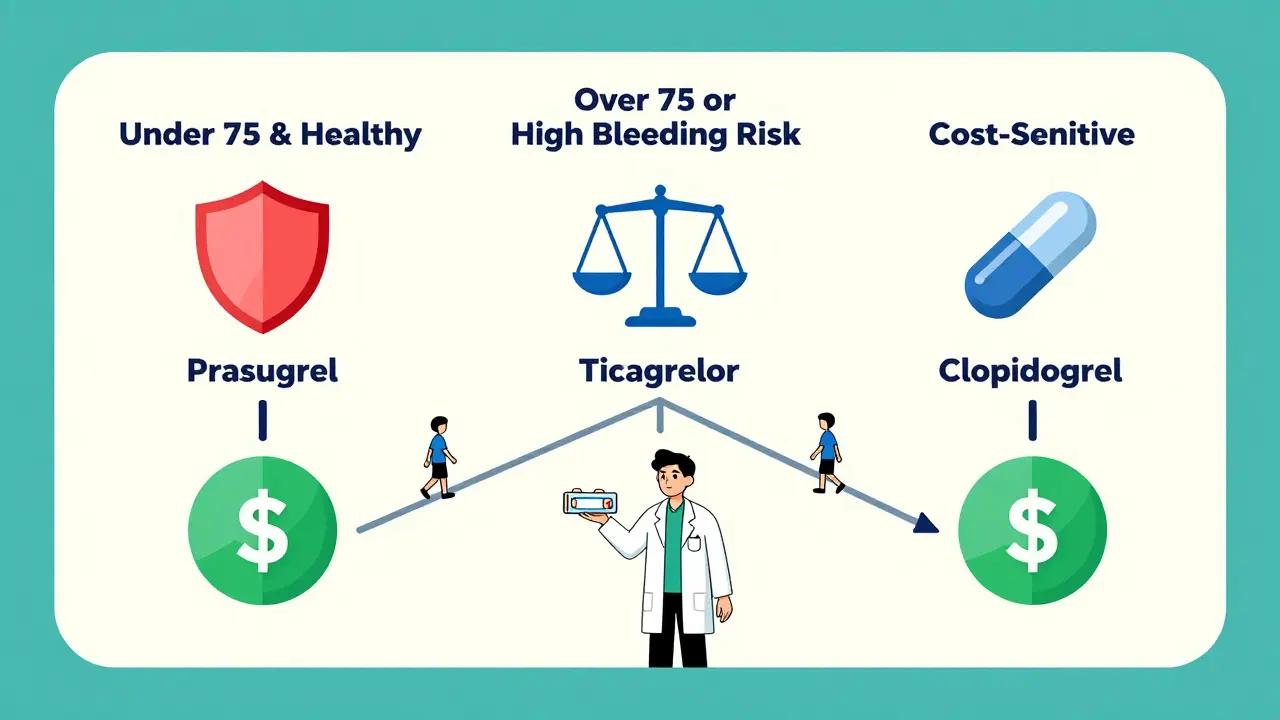
- If you’re under 75, no history of stroke, and having a stent for a heart attack-prasugrel is often the first choice. Strongest protection.
- If you’re over 75, have diabetes, or are at high risk for bleeding-ticagrelor is preferred. Better balance of benefit and safety.
- If cost is a major issue, and you’re not in a high-risk genetic group-clopidogrel still works. It’s $10 a month as a generic.
Real-world use reflects this. In 2023, clopidogrel made up 60% of prescriptions because of price. Ticagrelor held 30%, mostly in hospitals and younger patients. Prasugrel was only 10%, mostly for high-risk PCI cases.
Doctors are learning to personalize. A 62-year-old man with a big heart attack and no other health problems? Prasugrel. A 78-year-old woman with kidney disease and a history of stomach ulcers? Ticagrelor. A 55-year-old on Medicare with no insurance? Clopidogrel-with a plan to monitor for symptoms.
The Future: Lower Doses and New Options
The 2023 FDA approval of 30 mg ticagrelor is a game-changer. The MATTERHORN trial showed it cut bleeding by 25% compared to the standard 90 mg twice daily. It’s now recommended for long-term use after the first 6-12 months. This could reduce side effects and help people stay on therapy longer.
Next up? Selatogrel. It’s a new drug you inject under the skin during a heart attack. It works in minutes, wears off fast, and doesn’t need liver activation. Phase 3 trials are underway. If it works, it could replace oral drugs in emergency settings.
Platelet testing is still experimental. You can measure how well your blood clots, but no one agrees on when to use it. Right now, it’s mostly for research.
What Should You Do?
If you’re on one of these drugs:
- Don’t stop it without talking to your doctor-even if you feel fine.
- Report any unusual bleeding: nosebleeds that won’t stop, blood in stool, dark urine, headaches with vision changes.
- If you’re on ticagrelor and suddenly can’t catch your breath, call your doctor. Don’t assume it’s anxiety.
- Know your drug’s name and dose. Don’t let pharmacies switch it without telling you.
- Ask if genetic testing makes sense for you-especially if you’ve had a clot while on clopidogrel.
There’s no perfect drug. Each has trade-offs. The goal isn’t to find the strongest one-it’s to find the one that protects your heart without putting you at greater risk of bleeding or other side effects.
Can I switch from clopidogrel to ticagrelor if I’m not feeling well?
Yes, but only under medical supervision. Switching isn’t as simple as stopping one and starting another. Your doctor will consider your bleeding risk, kidney function, and why you’re not tolerating clopidogrel. If you’re having a clot despite taking it, switching to ticagrelor or prasugrel is often recommended. If you’re just having side effects like mild stomach upset, they might suggest adding a stomach protector instead.
Does ticagrelor cause weight gain or fatigue?
No, weight gain and fatigue aren’t listed side effects in clinical trials. But some people report feeling tired after starting ticagrelor. This could be due to the dyspnea-struggling to breathe makes you exhausted. Or it could be unrelated, like anemia from minor bleeding or another condition. Always check with your doctor before assuming it’s the drug.
Is prasugrel safe for older adults?
Generally, no. Prasugrel is not recommended for patients over 75 due to significantly higher bleeding risk. Studies show older patients on prasugrel have nearly triple the rate of major bleeding compared to younger ones. If you’re over 75 and need an antiplatelet, ticagrelor or low-dose clopidogrel are safer choices. There are rare exceptions-for example, if you’re 76 but very healthy and had a massive heart attack-but those are decided case by case.
Can I take ibuprofen or aspirin with these drugs?
Aspirin is usually part of your regimen-this is called dual antiplatelet therapy. But ibuprofen and other NSAIDs like naproxen can increase bleeding risk and may interfere with clopidogrel’s effectiveness. If you need pain relief, acetaminophen (Tylenol) is safer. If you must take an NSAID, use the lowest dose for the shortest time and talk to your doctor first.
How long do I need to stay on these drugs?
It depends. After a heart attack or stent, most people take both aspirin and a P2Y12 inhibitor for 6 to 12 months. After that, many switch to aspirin alone. But if you’re at high risk for another clot-like if you have diabetes, multiple stents, or a second heart event-your doctor might keep you on ticagrelor (60 mg twice daily) or clopidogrel long-term. Never stop without consulting your cardiologist.
Choosing the right antiplatelet isn’t about picking the strongest one. It’s about matching the drug to your body, your risks, and your life. The best choice is the one you can take safely, consistently, and without side effects that make you quit.


Write a comment