
FDA Serious Adverse Event Checker
Check Your Event
Select all criteria that apply to your situation. This tool uses FDA's 5-point definition to determine if your event qualifies as a serious adverse event.
What the FDA Considers a Serious Adverse Event
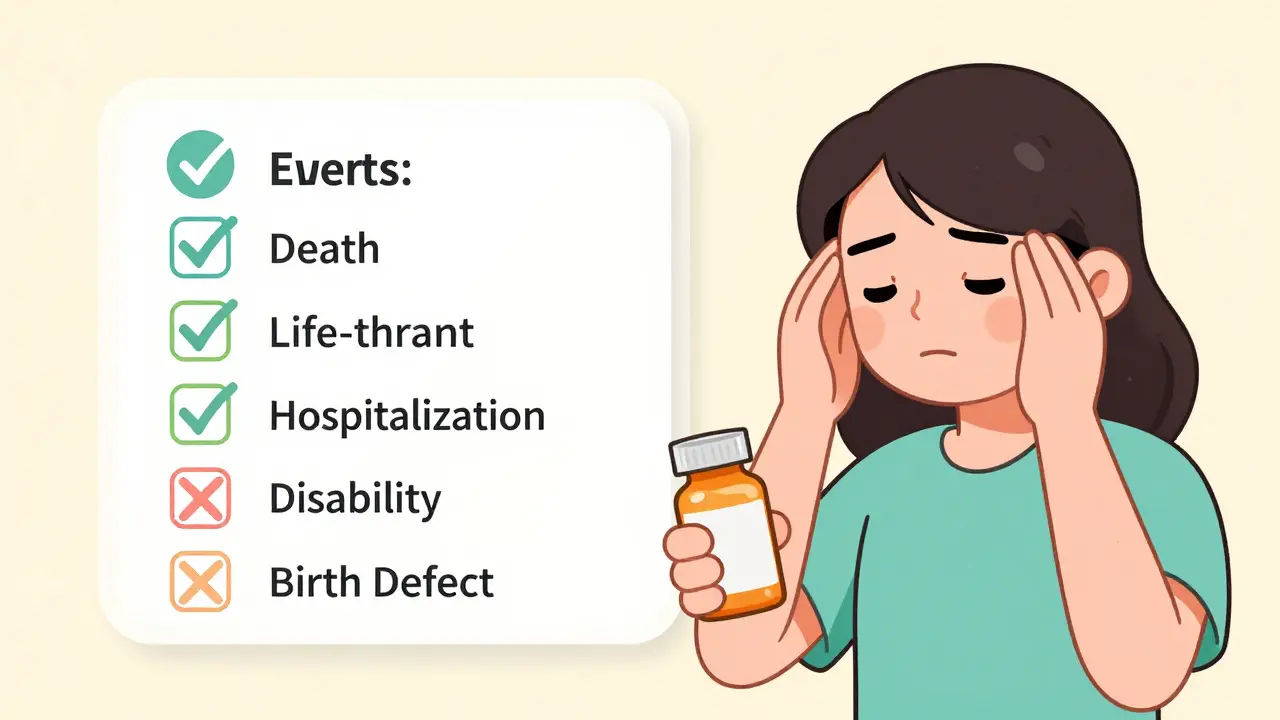
The FDA defines serious adverse events by these five criteria:
- Death — even if only suspected to be related
- Life-threatening — immediate danger of dying
- Hospitalization — requiring admission or extended stay
- Disability or permanent damage — changes to body or function
- Birth defect — if pregnant
Note: Any one of these outcomes makes an event serious — even if the symptoms were mild.
When you’re in a clinical trial or starting a new medication, you might see the term serious adverse event in your consent form or medication guide. It sounds scary. But here’s the truth: not every bad reaction is a serious adverse event - and not every serious one feels severe. Confusing the two is common, and it causes unnecessary panic. The FDA doesn’t use "serious" to mean "bad" or "intense." It uses it to mean "dangerous in a specific, measurable way." Understanding this difference isn’t just helpful - it’s lifesaving.
What the FDA Actually Means by "Serious"
The U.S. Food and Drug Administration defines a serious adverse event (SAE) by five clear outcomes. If any one of these happens, it’s classified as serious - no matter how mild the symptoms seemed at first:- Death - even if it’s only suspected to be linked to the drug or device.
- Life-threatening - meaning you were in real danger of dying at the time of the event. Not just "could have died" later - it had to be immediate.
- Hospitalization - whether it was your first admission or you stayed longer than 24 extra hours because of the reaction.
- Disability or permanent damage - something that changes your body or ability to live normally, like nerve damage from a drug or loss of vision.
- Birth defect - if you’re pregnant and the medicine causes a congenital anomaly.
There’s also a catch-all category called "Important Medical Events" - or IMEs. These are situations that don’t fit the above five but still need urgent attention. For example, a sudden drop in blood pressure that didn’t land you in the hospital but required emergency IV fluids to stabilize you. The FDA says: if it could lead to one of the five outcomes above, it counts as serious.
Here’s what doesn’t count: a bad headache, nausea that goes away in a day, or even a fever that lasts 48 hours unless it leads to hospitalization. These might be unpleasant - even severe - but they’re not serious under FDA rules.
Why "Severe" Isn’t the Same as "Serious"
This is where most patients get tripped up. A Grade 3 side effect - like severe diarrhea or low blood cell counts - sounds terrifying. But if it doesn’t cause hospitalization, permanent damage, or threaten your life, it’s not classified as a serious adverse event.Think of it this way: in cancer trials, 68% of Grade 3 or 4 side effects (the most intense on the scale) were not labeled as serious because they were expected, reversible, and didn’t meet the FDA’s outcome criteria. One patient, "CancerWarrior2022," shared on a support forum: "I panicked when I saw Grade 4 neutropenia listed. My nurse explained: it’s serious to doctors because it needs treatment, but it’s not an SAE because it’s common and fixable with a shot. That changed everything."
On the flip side, a mild rash that leads to an allergic reaction requiring ER care becomes a serious event - even if the rash itself was barely noticeable. The FDA doesn’t care how bad the symptom feels. They care about what it does.
How This System Protects You
The whole point of tracking serious adverse events isn’t to scare patients. It’s to catch hidden dangers before they hurt more people.In 2022 alone, the FDA used SAE data to issue 128 safety alerts and change 47 drug labels. That means warnings were added, dosages were lowered, or entire uses were restricted because of patterns found in these reports. One example: a diabetes drug was pulled from the market for certain patients after SAE reports showed a spike in pancreatitis cases that weren’t obvious in early trials.
The FDA’s Sentinel Initiative now watches health records from 300 million Americans in near real-time. AI tools help flag unusual spikes - like a sudden jump in heart rhythm problems after a new antidepressant was prescribed. Without SAE reporting, those signals would stay buried in doctor’s notes.
And patients aren’t just passive subjects in this system. In 2022, over 38,000 patients reported side effects directly to the FDA through MedWatch Form 3500B - a 12% jump from the year before. That’s you, speaking up. That’s how the system gets smarter.
What You’ll See in Your Documents
If you’re in a clinical trial or prescribed a new drug, you’ll see SAE information in two places:- Medication Guides - these come with your prescription. Look for a section called "Warnings and Precautions." It will list serious side effects with percentages: "Serious infections occurred in 2.3% of patients." That’s an SAE.
- Clinical Trial Consent Forms - these will have a section titled "Risks and Discomforts." It should explain how events are tracked and reported. If it doesn’t define "serious adverse event" in plain language, ask for clarification.
The FDA now pushes sponsors to include a glossary in plain English: "An event that results in death, requires hospitalization, causes significant disability, or presents a life-threatening situation." If you don’t see that, it’s not up to standard.
What You Can Do - And Should Do
You don’t need to be a scientist to help make drugs safer. Here’s how you can act:- Know the five criteria. Write them down. Keep them on your phone.
- Track your symptoms. If you’re hospitalized, need emergency care, or have a sudden change in function - write it down. Note the date, what you were taking, and what happened.
- Report it. Go to MedWatch and fill out Form 3500B. You don’t need a doctor’s note. You don’t need to prove it. Just report what happened.
- Ask questions. If your doctor says, "This is a Grade 3 side effect," ask: "Is this considered a serious adverse event? Why or why not?"
One patient with Type 1 diabetes said: "Understanding that hospitalization for DKA counts as a serious event helped me recognize when to seek immediate care during the trial." That’s the power of knowing the difference.
The Gaps - And Why They Matter
No system is perfect. Experts estimate that only 1% to 10% of actual adverse events are reported. Most people don’t know they can report. Many think it’s the doctor’s job. Others fear being blamed.Industry bias is another issue. A 2022 study found that drug companies underreported serious events by 27% to 35% because they didn’t always label expected side effects as serious - even when they met the criteria.
And there’s a cultural gap. A 2021 study found that 23% of events considered serious by the FDA weren’t seen as serious in Japan - because their hospitalization rules are different. The FDA’s system is strict, but it’s also the most detailed in the world.
What’s changing? The FDA is now requiring all clinical trial registries to include patient-friendly summaries of serious events by 2025. A new patient education portal is launching in late 2024. And AI is helping sort through millions of reports faster than ever.
Final Thought: Your Voice Matters
Serious adverse events aren’t about scaring you. They’re about giving you the power to recognize danger - and the tools to speak up. You’re not just a number in a database. You’re the reason these rules exist.Next time you read "serious adverse event," don’t panic. Ask: "Does this match one of the five?" If yes - take action. If no - breathe. You’re not alone in this. Millions have been through the same confusion. And now, you know the difference.
What’s the difference between a serious adverse event and a side effect?
All serious adverse events are side effects, but not all side effects are serious. A side effect is any unwanted reaction to a drug - like a headache or nausea. A serious adverse event is a side effect that causes death, hospitalization, life-threatening danger, permanent damage, or a birth defect. Only those five outcomes make it "serious" under FDA rules.
If I get a Grade 3 side effect, is it automatically serious?
No. Grade 3 means it’s severe - like intense nausea or low blood cell counts - but it’s only a serious adverse event if it leads to one of the five FDA outcomes: death, hospitalization, life-threatening situation, disability, or birth defect. Many Grade 3 events are managed without hospitalization and aren’t classified as serious.
Can I report a side effect myself to the FDA?
Yes. Anyone can report a side effect using the FDA’s MedWatch Form 3500B. You don’t need a doctor’s note, proof, or even a diagnosis. Just describe what happened, what you were taking, and when. In 2022, over 38,000 patients reported directly - and those reports helped trigger safety reviews.
Why do some drug labels say "serious side effects occurred in X%"?
That percentage comes from clinical trials and reflects how many participants experienced one of the five FDA-defined serious outcomes. For example, if 2.3% of patients in a trial were hospitalized due to liver inflammation from the drug, that becomes a listed serious side effect. It’s not about how common the symptom is - it’s about how dangerous the outcome was.
What if I think a side effect was serious but wasn’t reported?
Report it anyway. The FDA’s system depends on patient input. Many serious events go unnoticed until multiple people report similar experiences. If you had an unexpected hospitalization or reaction that wasn’t listed, your report could help catch a pattern early. Don’t wait for someone else to speak up.


Write a comment