

Heart failure isn’t a single event-it’s a journey. You might not feel sick at first. Maybe your doctor found a heart murmur during a checkup, or an EKG showed something unusual. Or maybe you’ve been getting winded climbing stairs, and your ankles have been swelling. It’s not just aging. It’s your heart struggling. And the good news? How we manage it today is nothing like it was ten years ago. We’re not just treating symptoms anymore. We’re changing the course of the disease.
Understanding the Stages: It’s Not One Size Fits All
Heart failure doesn’t show up overnight. It builds. The 2023 AHA/ACC guidelines break it into four clear stages, and knowing which one you’re in changes everything.Stage A means you’re at risk-maybe you have high blood pressure, diabetes, or a family history of heart disease-but your heart still looks normal on scans. This is your chance to stop it before it starts. Control your blood pressure. Lose weight if needed. Quit smoking. These aren’t just "good ideas." They’re your best defense.
Stage B means your heart has structural damage-a past heart attack, a leaky valve, thickened walls-but you still don’t feel symptoms. This is where treatment becomes critical. ACE inhibitors are the standard here. If you can’t take them, ARBs are the backup. The goal? Stop it from turning into Stage C. Studies show these drugs cut the risk of developing full heart failure by nearly half.
Stage C is where most people get diagnosed. You’re tired. You’re short of breath. Your legs swell. Your heart is damaged and showing signs. This is where the game-changing quadruple therapy kicks in. For those with reduced ejection fraction (HFrEF, LVEF ≤40%), four drugs now work together to save lives: an ARNI (like sacubitril/valsartan), a beta-blocker (carvedilol or bisoprolol), a mineralocorticoid antagonist (spironolactone), and an SGLT2 inhibitor (dapagliflozin or empagliflozin).
Each one has proof behind it. ARNI cuts death and hospitalizations better than old-school ACE inhibitors-number needed to treat (NNT) is just 12 over three years. Beta-blockers? NNT of 17. SGLT2 inhibitors? Even for people without diabetes, they lower hospital stays by 25%. These aren’t optional add-ons anymore. They’re the new baseline.
Stage D is advanced. Your heart is failing despite all treatments. You’re in and out of the hospital. You might need a pump (LVAD) or a transplant. Or, for some, the focus shifts to comfort-quality over quantity. This stage isn’t about giving up. It’s about choosing what matters most: more time? Less pain? Being home with family? The decision belongs to you, with support from your care team.
The HFpEF Revolution: Finally, Real Hope
For decades, heart failure with preserved ejection fraction (HFpEF, LVEF ≥50%) was a mystery. Doctors could manage the swelling and the breathlessness, but there were no drugs that actually changed outcomes. Diuretics helped with fluid, but they didn’t save lives.That changed in 2021 with the EMPEROR-PRESERVED trial. Empagliflozin, a drug originally for diabetes, cut the risk of hospitalization or death from heart failure by 21%. Then came DELIVER in 2022 with dapagliflozin-18% reduction. Suddenly, HFpEF wasn’t untreatable anymore. By 2023, SGLT2 inhibitors got a Class I recommendation-the strongest possible-for all HFpEF patients, regardless of diabetes status.
One patient on Reddit shared: "After starting empagliflozin, my 6-minute walk jumped from 320 meters to 410. No hospital visits in 18 months-before, I was going in every 4 months." That’s not an outlier. It’s becoming the norm.
But it’s not magic. The absolute benefit is modest-about 1.6% lower risk over two years. That’s why patient selection matters. If you’re 80, with multiple other conditions, and not very active, the trade-off might not be worth it. But if you’re still walking, working, caring for grandchildren? This drug can give you back years.
Monitoring Tech: When Your Heart Talks to Your Doctor
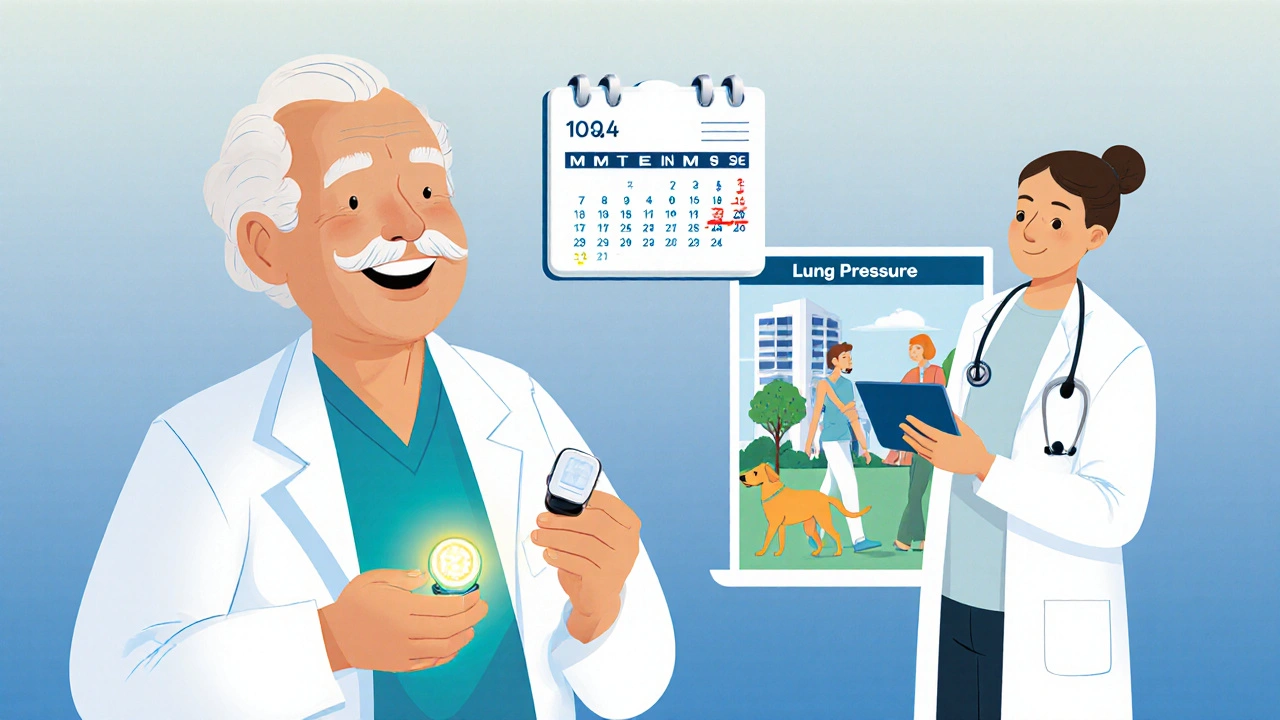
The CardioMEMS HF System is a tiny sensor implanted in your pulmonary artery. It doesn’t beep. It doesn’t glow. But every day, it measures pressure inside your lungs. That pressure rises hours or days before you feel swelling or breathlessness.Doctors use that data to adjust your diuretics before you end up in the ER. The 2025 MONITOR-HF trial confirmed what earlier studies hinted at: patients with CardioMEMS had 28% fewer hospitalizations and reported better quality of life. It’s not for everyone-it’s expensive, requires a minor procedure, and needs regular check-ins. But for those who’ve been hospitalized three times in a year? It’s life-changing.
And here’s something surprising: 78% of users say they feel more in control. They don’t have to guess if their swelling is serious. The device tells them-and their doctor-before it becomes a crisis.
The Hypotension Myth: Why Fear Is Holding You Back
Doctors often hesitate to push heart failure meds because they’re afraid of low blood pressure. "I’m worried he’ll pass out," they say. But here’s the truth: in real-world data, only 1.8% of heart failure patients actually have systolic blood pressure below 90 mmHg. That’s less than 1 in 50.Yet, 47% of clinicians say hypotension is their biggest barrier to optimizing treatment. Why? Because they think it’s common. A 2024 study found that doctors overestimated low blood pressure rates by five times. That’s not caution-it’s misinformation.
For HFpEF patients, low BP does carry more risk. But for HFrEF? The benefits of full-dose therapy far outweigh the tiny chance of dizziness. Most people adapt. The key? Slow titration. Start low. Go slow. Check in weekly. Most patients never crash. But many miss out on life-saving doses because of fear.
Why So Few Get the Full Treatment
The science is clear. Quadruple therapy for HFrEF saves lives. But only 39% of eligible patients get all four drugs within a year of diagnosis. The median time to start ARNI? Over 11 months.Why? Three big reasons:
- Doctors don’t know the guidelines well enough (42% of cases)
- They’re scared of side effects (32%)
- The pill burden is overwhelming (26%)
One patient’s caregiver said: "My husband takes eight heart meds, plus pills for diabetes, kidney, and cholesterol. I keep a chart on the fridge. Still, he misses doses. It’s too much." The average HFrEF patient takes 7.3 medications daily. No wonder people get confused.
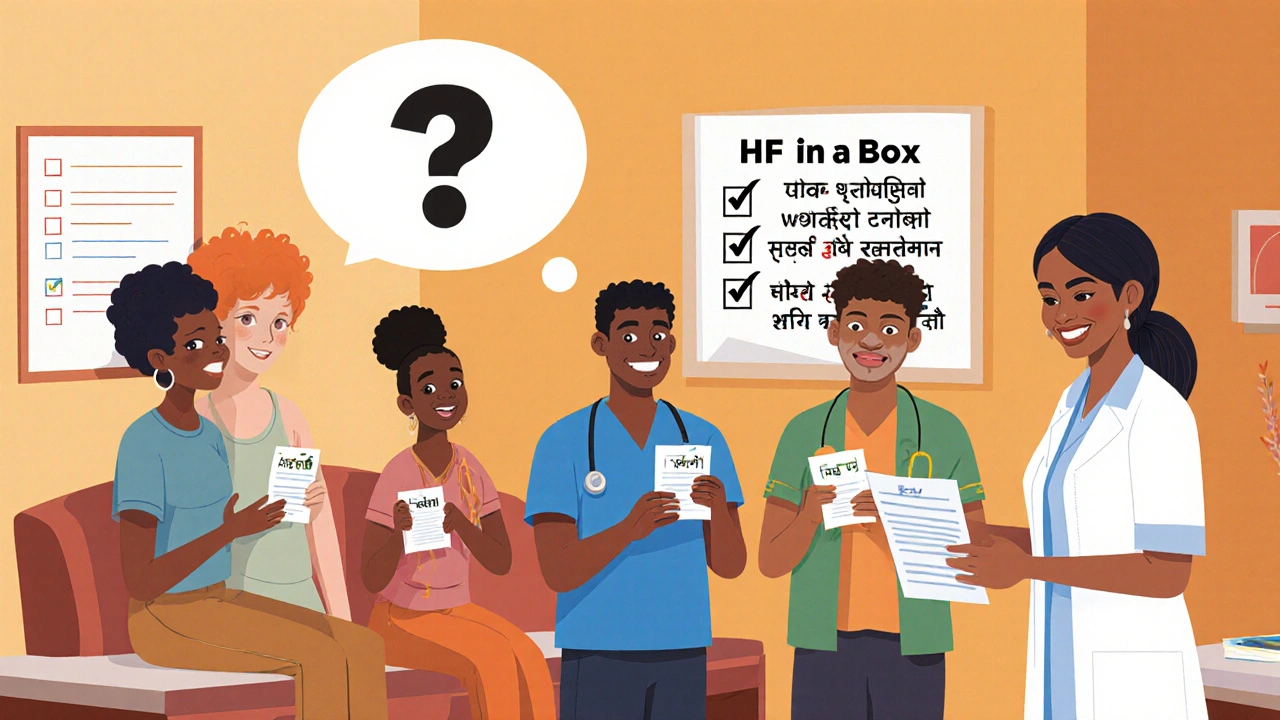
The ACC’s "HF in a Box" toolkit helps. It gives clinics checklists, patient handouts in 17 languages, and decision trees. Clinics using it saw a 27% jump in quadruple therapy use within six months. It’s not about working harder. It’s about working smarter.
The Real Gap: Race, Access, and Equity
Black patients are 37% less likely to get guideline-recommended therapy. They also have 28% higher death rates-even after adjusting for income, education, or insurance. This isn’t about access alone. It’s about bias, communication, and system design.One study found that Black patients were less likely to be referred for advanced therapies like LVADs. Another showed they were more likely to be told their symptoms were "just aging." These aren’t just statistics. They’re lived experiences.
Fixing this means training providers to recognize bias. It means using plain-language materials. It means community health workers who speak the same language-literally and culturally. It means asking patients: "What do you need to take your meds every day?" Not just "Did you take them?"
What You Can Do Today
You don’t need to understand every drug name or trial. But you do need to know this:- If you have heart failure, ask: "Am I on all four recommended meds?" (For HFrEF)
- If you have HFpEF, ask: "Could an SGLT2 inhibitor help me?"
- If you’re hospitalized often, ask: "Is CardioMEMS an option?"
- If you’re overwhelmed by pills, ask: "Can we simplify this?"
- If you’re feeling hopeless, say it. There are support groups, apps, and counselors who specialize in heart failure.
Heart failure is serious. But it’s not a death sentence. With the right treatment, people live longer, feel better, and stay out of the hospital. The tools are here. The science is solid. The only thing missing now is action-yours and your doctor’s.
What’s Next: The Future Is Personal
Researchers are now looking at Clonal Hematopoiesis of Indeterminate Potential (CHIP)-a hidden genetic quirk in 15-20% of older adults that inflames the heart. A trial called INTERCEPT-HF is testing whether blocking inflammation with canakinumab can help these patients.Another trial, TARGET-HF, is testing personalized blood pressure targets. Maybe your ideal BP isn’t 120/80. Maybe it’s 130/85. Or 110/70. The goal? Tailor treatment to your biology, not a one-size-fits-all number.
These aren’t distant dreams. They’re happening now. And they’ll make heart failure management even more precise-less trial and error, more precision.
Can heart failure be reversed?
In some cases, yes-especially if caught early. Stage A and B heart failure can often be stopped or slowed with lifestyle changes and medications. For Stage C, especially with HFrEF, quadruple therapy can improve heart function over time. Some patients see their ejection fraction rise from 25% to 45% after a year of full treatment. It’s not a cure, but it’s a major improvement. The heart doesn’t always heal, but it can recover enough to let you live well.
Do I need to stop all salt if I have heart failure?
You don’t need to go salt-free, but you do need to cut back. Aim for less than 2,000 mg of sodium per day. That’s about one teaspoon. Read labels-bread, soup, sauces, and processed foods are the biggest hidden sources. A little salt won’t hurt, but too much makes fluid build up, and that’s what causes swelling and breathlessness. Work with a dietitian to find realistic ways to reduce it without making meals tasteless.
Can I still exercise with heart failure?
Yes-and you should. Regular, moderate exercise like walking, cycling, or seated strength training improves strength, reduces fatigue, and lowers hospital risk. Start slow: 10 minutes a day, three times a week. Build up to 30 minutes most days. Cardiac rehab programs are designed for this. They monitor you, adjust your meds, and teach you how to recognize warning signs. Don’t wait until you feel better to move. Movement helps you feel better.
What if I can’t afford my heart failure meds?
You’re not alone. SGLT2 inhibitors can cost over $500 a month. But most manufacturers have patient assistance programs. Ask your pharmacist or doctor-they can connect you. Medicare Part D plans often cover these drugs. Some states have prescription assistance programs. Never stop taking meds because of cost. There are options. Just ask.
How often should I see my doctor?
When you’re first diagnosed or after a hospital stay, expect to see your doctor every 2-4 weeks. Once things stabilize, every 3-6 months is typical. But if you gain 2+ pounds in a day, feel more short of breath, or your ankles swell suddenly-call your doctor that day. These are warning signs. Don’t wait for your next appointment. Quick action can prevent a hospital trip.
Are natural supplements safe with heart failure meds?
Some are dangerous. St. John’s Wort can lower blood levels of beta-blockers. Potassium supplements can cause dangerous spikes if you’re on spironolactone. Even garlic or fish oil can interact. Always tell your doctor about every supplement, herb, or vitamin you take. What’s "natural" isn’t always safe-especially with heart failure.


Write a comment