

When women with PCOS notice coarse, dark hair growing on their upper lip, chin, chest, or back, it’s not just a cosmetic concern-it’s a sign of hormonal imbalance. About 70-80% of women with PCOS experience hirsutism, making it one of the most common and distressing symptoms. While many try shaving, waxing, or threading just to keep up, these methods don’t touch the root cause: excess androgens. The good news? Medications called antiandrogens can help. But they’re not a quick fix, and they’re not for everyone.
What Exactly Is Hirsutism in PCOS?
Hirsutism isn’t just having more body hair. It’s when terminal hair-thick, dark, and coarse-appears in areas where men typically grow it: face, chest, abdomen, and lower back. In women with PCOS, this happens because their ovaries and adrenal glands produce too many androgens, like testosterone. These hormones stimulate hair follicles in ways that lead to unwanted growth.It’s not about quantity-it’s about type. Fine, light vellus hair is normal everywhere. But when that turns into coarse, dark hair in androgen-sensitive zones, it’s hirsutism. Doctors use the modified Ferriman-Gallwey (mFG) score to measure it, counting hair growth in nine body areas. A score above 8 is considered hirsutism. Many women with PCOS start with scores of 15 or higher.
Why Antiandrogens? The Science Behind Them
Antiandrogens don’t remove hair. They slow down the process by blocking the hormones that make it grow. There are three main ways they work:- Block androgen receptors - so testosterone can’t bind to hair follicles
- Inhibit androgen production - reduce how much testosterone the body makes
- Stop testosterone from turning into DHT - dihydrotestosterone is the strongest driver of hair growth
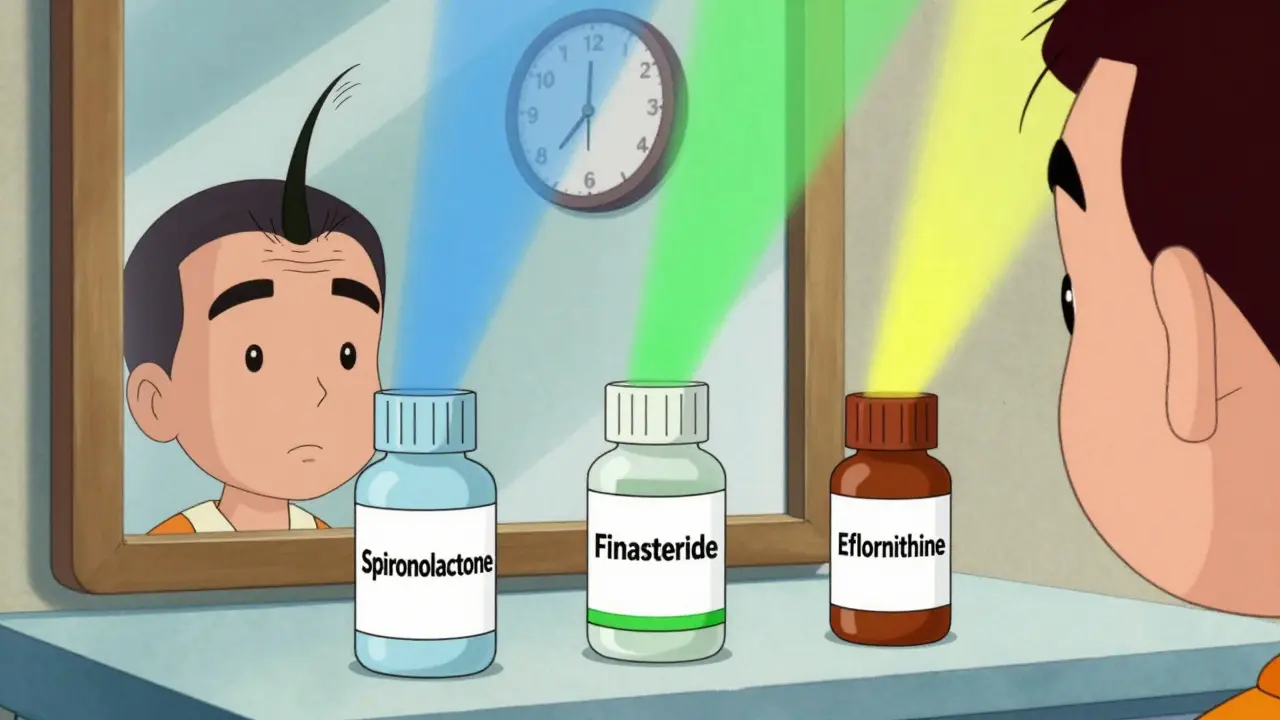
Three drugs are currently used for this in PCOS: spironolactone, finasteride, and eflornithine cream. Each works differently.
Spironolactone (50-200 mg/day) blocks androgen receptors and also weakly stops the enzyme that makes testosterone. Finasteride (2.5-5 mg/day) is more targeted-it blocks the 5-α-reductase enzyme that turns testosterone into DHT. Eflornithine (Vaniqa) is a cream applied to the skin. It doesn’t affect hormones at all. Instead, it slows down an enzyme in hair follicles called ornithine decarboxylase, which slows hair growth.
These aren’t magic pills. They take time. Most women see noticeable changes only after 6 to 9 months. Full results can take up to two years. That’s why so many people quit too soon.
Antiandrogens Aren’t First-Line-Here’s Why
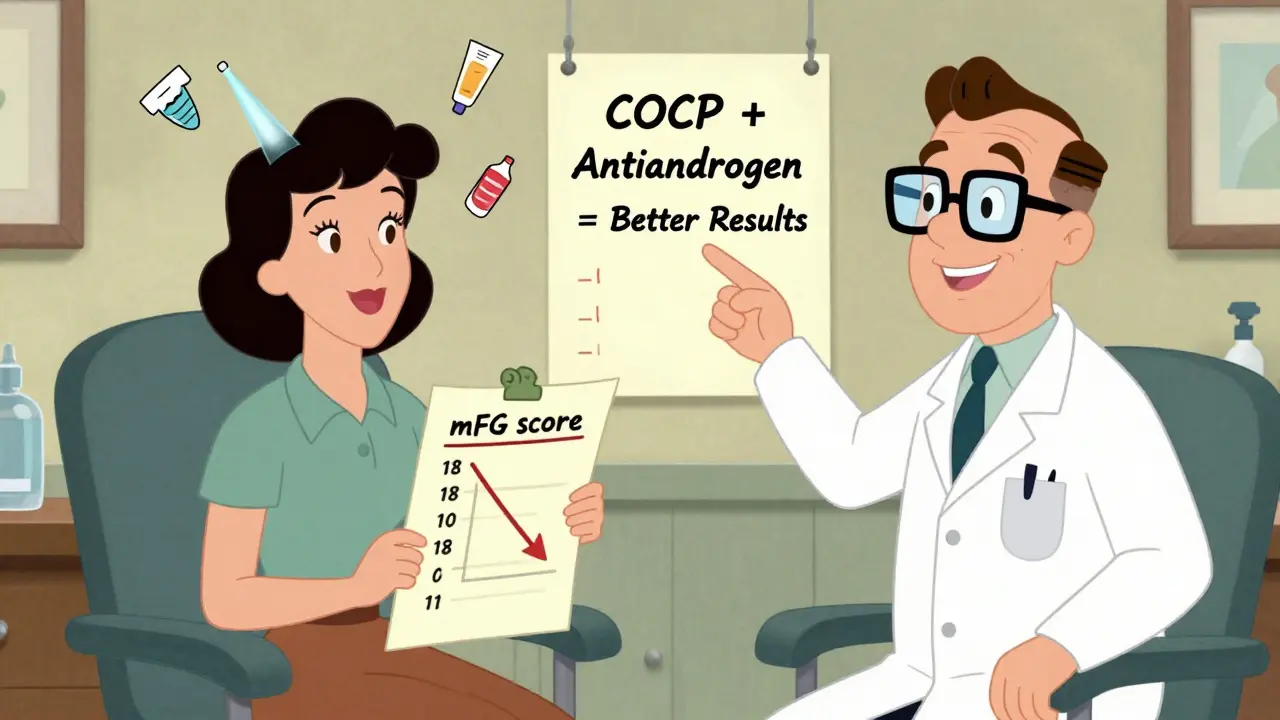
Many assume antiandrogens are the go-to treatment. They’re not. Combined oral contraceptive pills (COCPs) are still the first choice for PCOS-related hirsutism. Why? They lower androgen production from the ovaries and increase sex hormone-binding globulin (SHBG), which binds up free testosterone. Studies show COCPs reduce mFG scores by about 2-4 points over 6-12 months.Antiandrogens only come in when COCPs don’t work-or can’t be used. That might be because:
- You have a history of blood clots
- You get migraines with aura
- You can’t tolerate the side effects (nausea, mood swings, breakthrough bleeding)
- You’ve been on them for six months with little improvement
According to the 2023 International Evidence-based Guideline for PCOS, antiandrogens should never replace COCPs as first-line therapy. They’re a backup plan. And even then, they’re often used with a COCP, not instead of it.
Comparing the Top Antiandrogens
| Medication | Dosage | How It Works | Time to See Results | Common Side Effects | Contraception Required? |
|---|---|---|---|---|---|
| Spironolactone | 50-200 mg daily | Blocks androgen receptors and reduces testosterone production | 6-12 months | Dizziness, menstrual irregularities, fatigue, increased urination | Yes (dual method) |
| Finasteride | 2.5-5 mg daily | Blocks conversion of testosterone to DHT | 6-12 months | Headache, decreased libido (rare), potential sexual side effects | Yes (FDA Category X-strictly avoid pregnancy) |
| Eflornithine Cream (Vaniqa) | Apply twice daily to affected areas | Slows hair growth by inhibiting ornithine decarboxylase | 4-8 weeks (surface effect) | Skin irritation, burning, stinging | No |
Spironolactone is the most commonly prescribed because it’s affordable and effective. Generic versions cost under $50 for a 30-day supply. Finasteride works well for facial hair, especially on the upper lip and chin, but can cost over $200/month without insurance. Eflornithine cream doesn’t help with body hair, only facial hair-but it’s safe during pregnancy (though not recommended for use then).
What About Combining Treatments?
Doctors often layer treatments. For example:- COCP + spironolactone → better hormone control + direct hair suppression
- Spironolactone + eflornithine cream → systemic + topical action
- Antiandrogen + laser therapy → reduces hair growth + removes existing hair
A 2023 clinical pearl from Exxcellence.org found that adding eflornithine cream to laser treatments boosted hair reduction by 35% compared to laser alone. That’s huge for someone who’s tired of monthly waxing.
But combining treatments isn’t always better. One study showed that adding spironolactone to a COCP worsened lipid profiles-raising bad cholesterol and lowering good cholesterol. So if you’re already at risk for heart disease, this combo might not be worth it.
Real Patient Experiences
Reddit’s r/PCOS community has over 125,000 members. Reading their posts gives a raw view of what this really feels like.One user, "PCOSWarrior2020," wrote: "After 8 months of Yaz with no improvement in chin hair, my doctor added 100mg spironolactone daily. At 6 months on the combo, my mFG score dropped from 18 to 11-noticeable but not perfect."
Another, "HirsuteHannah," said: "Spironolactone 200mg caused constant dizziness and menstrual irregularities, so I switched to finasteride which worked better but cost $85/month cash price."
On RealSelf, 58% of users said spironolactone was "worth it," but 42% said the side effects were worse than the hair. Eflornithine got 49% positive ratings-many liked that it didn’t affect hormones, but hated the cost and the need for daily application.
Cost is a huge barrier. A 30-day supply of Vaniqa cream can run $245. Generic spironolactone? Around $46. That’s why many women stop after a few months-especially if they’re uninsured.
What You Need to Know Before Starting
If you’re considering antiandrogens, here’s what your doctor should cover:- You need two forms of birth control-because these drugs can cause serious birth defects. Even if you’re not sexually active, you still need contraception. Spironolactone is Category B (not proven harmful), but finasteride is Category X (known to cause harm).
- Spironolactone can raise potassium-if you have kidney problems or take blood pressure meds like ACE inhibitors, you need regular blood tests.
- Start low, go slow-beginning at 25-50 mg of spironolactone helps avoid dizziness and fatigue. Increase gradually over months.
- Results take time-no one sees changes in 2 weeks. If you don’t see improvement after 6 months, it’s unlikely to work.
- Complete hair removal isn’t possible-you’re aiming for less density, less coarseness, fewer follicles that grow dark hair.
What’s Next? The Future of Treatment
The 2023 guidelines marked a shift. For the first time, antiandrogens were formally recognized as second-line options for PCOS hirsutism. Before that, evidence was too weak.Now, researchers are looking at new drugs. One, called enobosarm (GTx-024), is a selective androgen receptor modulator (SARM). Early trials show it reduces hirsutism by 28% more than placebo-with fewer side effects. Results are expected in mid-2024.
Also, genetic testing is being explored. Some women are more sensitive to androgens because of their DNA. In the future, doctors might test for these markers and tailor treatment before even starting medication.
Laser and IPL hair removal are growing fast. The global market is projected to hit $1.8 billion by 2027. More women are combining medication with light-based treatments because it cuts down the number of sessions needed.
Final Thoughts: Is It Worth It?
Hirsutism in PCOS is frustrating. It’s visible. It’s persistent. It affects confidence, relationships, and mental health. Antiandrogens can help-but they’re not a cure. They’re a tool. One that requires patience, discipline, and medical oversight.If you’ve tried birth control for six months with no change, talk to your doctor about adding an antiandrogen. If you can’t take hormonal pills, spironolactone or finasteride might be your best bet. If you just want to reduce facial hair without pills, eflornithine cream is an option.
But remember: consistency beats intensity. Taking your pill daily, applying cream twice a day, showing up for laser sessions-it all adds up. And in 12 to 18 months, you might look in the mirror and realize you haven’t needed to thread in weeks.
Can antiandrogens completely remove hair in PCOS?
No. Antiandrogens reduce hair growth, density, and coarseness, but they don’t eliminate follicles. Complete hair removal isn’t possible with medication alone. For that, you need laser or electrolysis. Antiandrogens make those procedures more effective by slowing down regrowth.
How long before I see results from spironolactone?
Most women start noticing changes around 6 months, with the best results appearing between 12 and 18 months. Hair growth cycles are slow-each follicle takes 3-6 months to turn from fine to coarse, and the same time to revert. Patience is key.
Is finasteride safe for women with PCOS?
Yes, when used under medical supervision and with strict contraception. Finasteride is FDA-approved for men with hair loss, but it’s used off-label for women with PCOS. The main risk is birth defects if taken during pregnancy. It’s also been linked to rare, persistent sexual side effects in some women. Talk to your doctor about alternatives if you’re concerned.
Can I use eflornithine cream without other treatments?
Yes. Eflornithine cream works independently of hormones, so it’s safe to use alone. It’s especially helpful for facial hair if you can’t take oral medications or want to avoid systemic side effects. But it only works on the skin where you apply it-so it won’t help with chest or back hair.
Why do some women gain weight on spironolactone?
Spironolactone is a diuretic, so many people lose water weight at first. But some report long-term weight gain. This isn’t due to fat gain-it’s often fluid retention from hormonal shifts or increased appetite. It’s not common, but if you notice unexplained weight gain, talk to your doctor. It may mean your dose is too high or you need to adjust other parts of your treatment plan.