
When you hear the word biosimilar, you might think it’s just a cheaper version of a brand-name drug. But monoclonal antibody biosimilars aren’t like generic pills you pick up at the corner pharmacy. They’re complex, living medicines made from living cells - not chemicals in a lab. And they’re changing how we treat cancer, autoimmune diseases, and other serious conditions.
What Makes Monoclonal Antibody Biosimilars Different?
Think of a brand-name monoclonal antibody like Herceptin or Avastin. These drugs are made by engineering human cells to produce specific proteins that target disease. Each molecule is huge - about 150,000 daltons - and even tiny changes in how it’s made can affect how it works. That’s why you can’t just copy them like you would aspirin.
A biosimilar isn’t identical. It’s highly similar. The U.S. FDA and Europe’s EMA both require manufacturers to prove there are no clinically meaningful differences in safety, effectiveness, or side effects compared to the original. That means rigorous testing: comparing protein structures, immune responses, and even how the body breaks the drug down. The process isn’t just about matching a chemical formula. It’s about matching behavior in the human body.
One big challenge? Glycosylation - the sugar molecules attached to the protein. A small change here can trigger unexpected immune reactions. In rare cases, patients developed allergic responses to cetuximab because of a sugar structure called alpha-1,3-galactose. That’s why regulators demand more than 120 analytical tests before approval.
Approved Monoclonal Antibody Biosimilars and What They Treat
As of 2025, dozens of monoclonal antibody biosimilars are approved in the U.S. and Europe. Here are the most common ones and the conditions they’re used for:
- Bevacizumab biosimilars (like Mvasi, Zirabev, Vegzelma): Used for colorectal, lung, ovarian, and brain cancers. Six versions are approved in the U.S., all matching Avastin’s ability to block blood vessel growth in tumors.
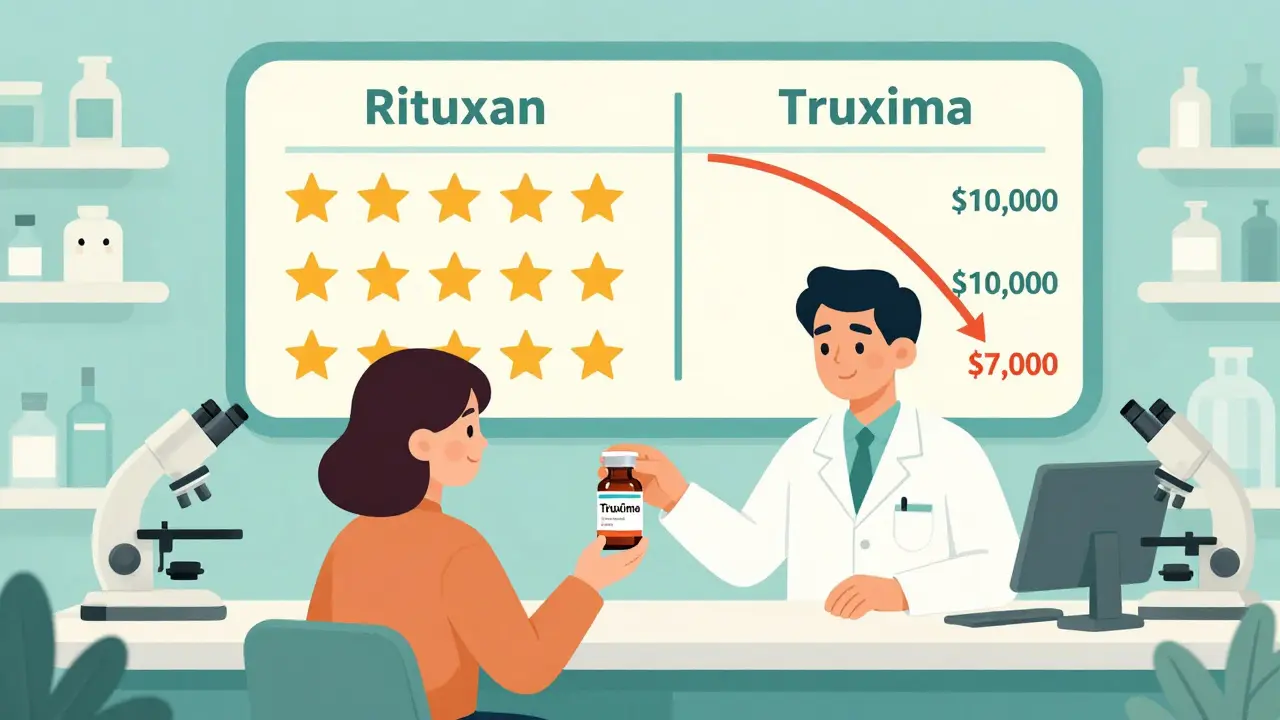
- Rituximab biosimilars (Truxima, Ruxience, Riabni): Treat non-Hodgkin’s lymphoma, chronic lymphocytic leukemia, and rheumatoid arthritis. A 2022 study of over 1,200 patients showed Truxima worked just as well as Rituxan - with 28% lower cost per treatment cycle.
- Trastuzumab biosimilars (Ogivri, Herzuma, Ontruzant, Trazimera, Kanjinti, Hercessi): Target HER2-positive breast and stomach cancers. These six biosimilars have replaced Herceptin in many clinics, with no drop in survival rates.
- Infliximab biosimilars (Remsima, Inflectra): Used for Crohn’s disease, ulcerative colitis, and rheumatoid arthritis. Remsima became the first monoclonal antibody biosimilar designated as “interchangeable” by the FDA in 2023 - meaning pharmacists can switch it for the brand without asking the doctor.
- Adalimumab biosimilars (Hyrimoz, Amjevita, Cyltezo): The first biosimilar for Humira hit the U.S. market in 2023. With over 14 candidates in development, this is one of the fastest-growing segments.
These aren’t just copies. They’re proven alternatives. In real-world use, oncologists report similar response rates, fewer hospitalizations for side effects, and no increase in serious infections.
How Much Do They Save?
Cost is the biggest driver behind biosimilar adoption. A single cycle of Herceptin can cost over $10,000. The biosimilar versions? Around $6,000 to $7,000. That’s a 30-40% drop.
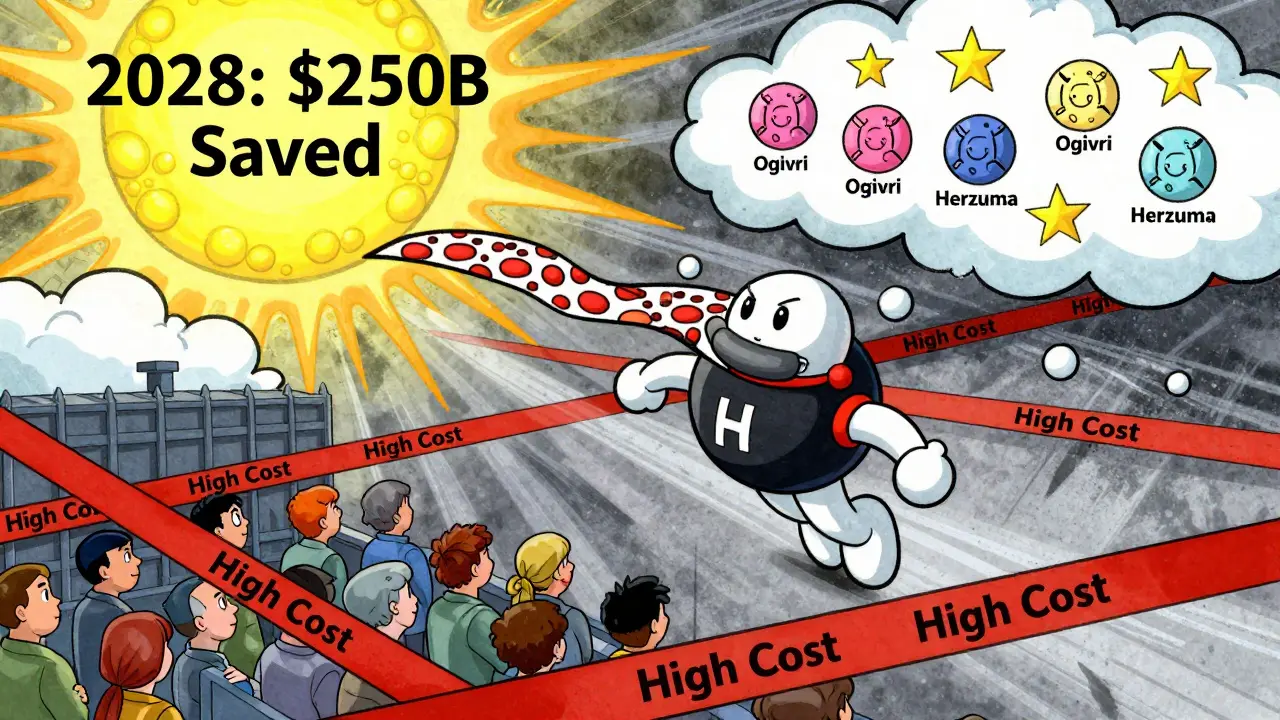
By 2028, analysts expect biosimilars for bevacizumab, trastuzumab, and rituximab alone to save the U.S. healthcare system $250 billion. That’s enough to cover treatment for hundreds of thousands of patients who couldn’t otherwise afford it.
But savings don’t happen automatically. Pharmacy benefit managers often delay coverage. Some hospitals still default to the brand name because of habit or fear. And patent lawsuits - an average of 15 per biosimilar - can delay market entry for years.
Are They Safe? What About Side Effects?
Some doctors worry about immunogenicity - the risk that the body will react against the biosimilar like a foreign invader. But data from over 1.2 million patient-years of exposure shows the rate of unexpected immune reactions is the same as the original drugs: about 0.001%.
The EMA and FDA both track safety through post-market surveillance. So far, no biosimilar has shown a new or worse safety profile. In fact, some patients report fewer infusion reactions with biosimilars - possibly because manufacturers tweak the formulation to improve stability.
One thing to remember: switching from the original to a biosimilar doesn’t increase risk. Multiple studies, including those in the Journal of Clinical Oncology and JAMA Oncology, show patients who switch do just as well as those who stay on the brand.
What’s Next? The Pipeline and Future Trends
The next wave of biosimilars is targeting even more complex drugs:
- Pembrolizumab (Keytruda) biosimilars: Six are in late-stage trials. Keytruda is the top-selling cancer drug in the world - its biosimilars could reshape immunotherapy access.
- Antibody-drug conjugates: Drugs like Enhertu, which deliver chemo directly to cancer cells, are being targeted. These are harder to copy because they combine a protein with a toxic chemical.
- Bispecific antibodies: These bind to two targets at once - a new frontier in cancer treatment. The EMA plans to release new guidance on these by mid-2024.
By 2027, monoclonal antibody biosimilars are expected to make up 35% of all biologic prescriptions in the U.S. - up from 18% in 2022. Cancer therapies will account for 62% of that volume.
Technology is keeping pace. Labs now use advanced mass spectrometry and AI-powered glycan mapping to compare biosimilars with near-perfect precision. The FDA’s 2023 draft guidance lists 127 specific analytical tests - more than ever before.
Why Aren’t They Used More?
Despite the savings and safety data, adoption is still uneven. Why?
- Provider education: A 2022 ASCO survey found only 58% of oncologists felt “very confident” prescribing biosimilars. Many still think they’re less effective.
- Formulary restrictions: Insurance companies sometimes require step therapy - forcing patients to try the brand first.
- Patient fear: Some patients assume “biosimilar” means “inferior.” Clear communication from doctors helps.
The fix? Education. Real-world data. And transparency. When patients hear that their biosimilar has been used safely in thousands of others - and that their doctor chose it because it works just as well - resistance drops.
Final Thoughts
Monoclonal antibody biosimilars aren’t a compromise. They’re a breakthrough. They bring life-saving treatments within reach for people who couldn’t afford them before. They’re not generics. They’re not copies. They’re carefully engineered alternatives that meet the highest standards of science and safety.
If you or someone you know is being treated for cancer, rheumatoid arthritis, or another chronic disease, ask: Is a biosimilar an option? The answer might be yes - and it could mean better care, at a lower cost.
Are monoclonal antibody biosimilars the same as generic drugs?
No. Generic drugs are chemically identical to their brand-name counterparts and are made from simple molecules. Monoclonal antibody biosimilars are complex proteins made from living cells. They’re highly similar, but not identical, to the original. That’s why they require much more testing to prove they work the same way in the body.
Can biosimilars be switched with the original drug safely?
Yes - for those designated as “interchangeable.” The FDA requires extra studies to prove that switching back and forth doesn’t increase risks. Remsima (infliximab) was the first monoclonal antibody biosimilar to get this status in 2023. Even non-interchangeable biosimilars have been safely used in clinical practice for years, with no increase in side effects when patients switch.
Which biosimilars are approved for breast cancer?
Six biosimilars are approved in the U.S. for HER2-positive breast cancer, all matching trastuzumab (Herceptin): Ogivri, Herzuma, Ontruzant, Trazimera, Kanjinti, and Hercessi. They’re used the same way - with chemotherapy or alone - and have shown identical survival rates in clinical trials.
Do biosimilars cause more side effects than the original drugs?
No. Large-scale studies and real-world data show the side effect profile is nearly identical. The EMA tracked 1.2 million patient-years of exposure and found no increase in immune reactions or serious adverse events. Some patients even report fewer infusion reactions with biosimilars due to improved formulations.
How do I know if my prescription is a biosimilar?
Check the drug name. Biosimilars have a four-letter suffix added to the nonproprietary name, like “-mab” for the original and “-xmkd” for the biosimilar. Your pharmacist or doctor can confirm. Also, biosimilars are often labeled as “biosimilar” on the box or prescription. If you’re unsure, ask - you have a right to know what you’re receiving.


Write a comment