
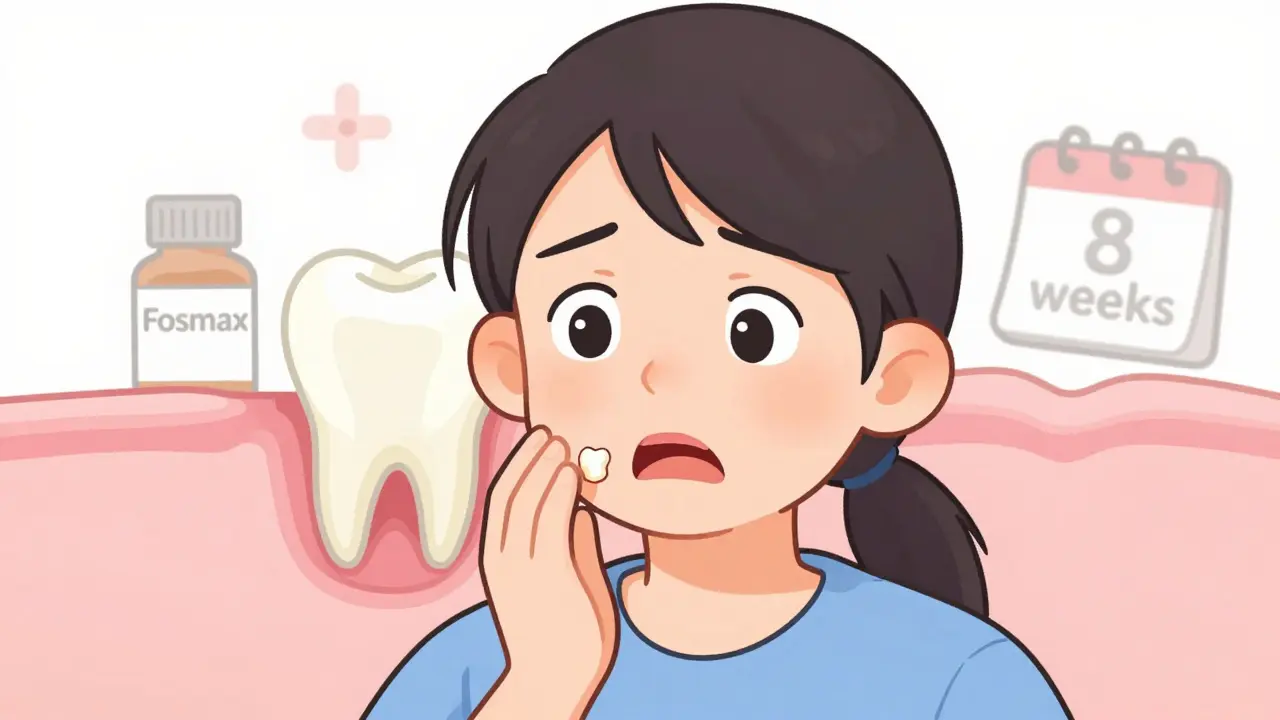
Imagine this: you’ve had a tooth pulled, and instead of healing like it should, your gum stays open. Weeks go by. The pain doesn’t go away. Your dentist says it’s an infection, gives you antibiotics, but nothing helps. Then, one day, you see it - a piece of bone sticking out where your tooth used to be. That’s not a routine complication. That’s osteonecrosis of the jaw - and it’s happening to more people than you think, especially if you’re on certain medications.
Osteonecrosis of the jaw (ONJ), also called medication-related osteonecrosis of the jaw (MRONJ), isn’t something that shows up overnight. It creeps in slowly, often mistaken for a bad toothache or gum infection. But when it’s triggered by medications, it can lead to serious, long-term damage. The jawbone stops healing. Blood flow gets cut off. Bone dies. And once it’s exposed, it doesn’t heal on its own. This isn’t rare in high-risk groups. For people taking intravenous drugs for cancer, the risk jumps to 1%-10%. Even for those on oral osteoporosis meds, it’s real - and preventable.
What Medications Cause Jaw Bone Death?
Not every medication causes this. But some do - and they’re more common than you realize. The biggest culprits are drugs that stop bone from breaking down. They’re great for preventing fractures in osteoporosis or slowing cancer spread to bone. But they also slow down the jaw’s natural repair system.
Here’s what’s linked to MRONJ:
- Bisphosphonates - These are the most common. Oral versions like alendronate (Fosamax), ibandronate (Boniva), and risedronate (Actonel) are used for osteoporosis. But the real danger comes from intravenous versions like zoledronate (Reclast), given to cancer patients.
- Denosumab (Prolia) - A newer drug, often used when bisphosphonates don’t work. It carries similar risk.
- Romosozumab - A newer bone-building drug, still being studied, but early data shows possible risk.
Here’s the key difference: if you’re taking oral bisphosphonates for osteoporosis, your risk is about 0.001% to 0.01%. That’s 1 in 10,000 to 1 in 100,000 people. But if you’re getting monthly IV infusions for bone metastases? Risk jumps to 1%-10%. That’s 100 to 1,000 times higher.
What Are the Real Warning Signs?
Most people don’t know what to look for. Dentists miss it. Patients brush it off. But there are clear signs - and they show up in predictable patterns.
- Exposed bone - This is the defining feature. If you can see bone in your mouth that’s been uncovered for more than 8 weeks, it’s ONJ. No exceptions.
- Pain or swelling - Not just a toothache. This is constant, deep, and doesn’t respond to painkillers. About 87% of cases report this.
- Poor healing after extraction - If your socket doesn’t close, keeps oozing, or gets worse after a week, that’s a red flag. 76% of diagnosed cases started with a tooth extraction.
- Loose teeth - Teeth that feel loose without trauma or gum disease? That’s unusual. Happens in 63% of cases.
- Pus or bad taste - Even if you brush and rinse, if your mouth tastes metallic or you have thick, foul-smelling discharge, it’s not just infection.
- Numbness or heaviness - Tingling, numbness, or a feeling of pressure in your jaw? 42% of patients report this. It means nerves are being affected.
These signs don’t show up all at once. They build. A tooth extraction. A sore that won’t heal. Then pain. Then bone showing. If you’re on one of these meds and notice even one of these, don’t wait. Go to a dentist who knows about MRONJ.
Why Does This Happen?
It’s not magic. It’s biology. Your jawbone is alive. Every day, old bone breaks down and new bone forms. It’s like a constant repair job. Bisphosphonates and denosumab stop that repair. They’re so good at it that they freeze bone turnover.
Here’s what that means in real terms:
- When you get a tooth pulled, your body normally sends cells to clean up the socket and rebuild bone.
- With these meds, that process stops. The socket doesn’t heal. The bone underneath dies.
- Even minor trauma - like a denture rubbing, or a routine cleaning - can trigger it in high-risk patients.
It’s not about the drug being “bad.” It’s about the jaw being uniquely vulnerable. Other bones in your body don’t get exposed like this. Your jaw is constantly under stress - chewing, talking, brushing. It needs to heal fast. These drugs prevent that.
Who’s at Highest Risk?
Not everyone on these meds gets ONJ. But some people are far more at risk.
- IV bisphosphonate users - Especially those getting monthly infusions for breast cancer, prostate cancer, or multiple myeloma.
- People on meds for 3+ years - Risk climbs after 3-4 years. After 5 years, oral bisphosphonate risk jumps from 0.002% to 0.015%.
- Those who’ve had dental work - Tooth extraction carries a 3.2% risk in users. Routine cleanings? No increased risk.
- People with diabetes or poor oral hygiene - Infection and healing problems make ONJ much more likely.
And here’s something most don’t realize: 92% of patients who had a full dental checkup before starting these meds never developed ONJ. That’s not luck. That’s prevention.
What Should You Do Before Starting?
If you’re about to start IV bisphosphonates or denosumab for cancer - or even oral bisphosphonates for osteoporosis - here’s what you need to do:
- See your dentist 4-6 weeks before starting - This isn’t optional. Get a full exam, X-rays, and cleaning. Fix cavities. Remove teeth that might cause problems later.
- Tell your dentist you’re on these meds - Don’t assume they know. Bring the name of the drug and your dosage. Many dentists still don’t ask.
- Avoid invasive procedures after starting - No extractions, implants, or bone surgery unless absolutely necessary. If you must have one, talk to your doctor about a 2-3 month drug holiday (for IV meds only).
- Use chlorhexidine rinse - A 0.12% mouthwash twice daily reduces risk by 37%. It’s simple, cheap, and proven.
For those already on the meds: keep up with cleanings. Brush and floss daily. Avoid smoking. If you need dental work, get it done - but only with a dentist who understands MRONJ.
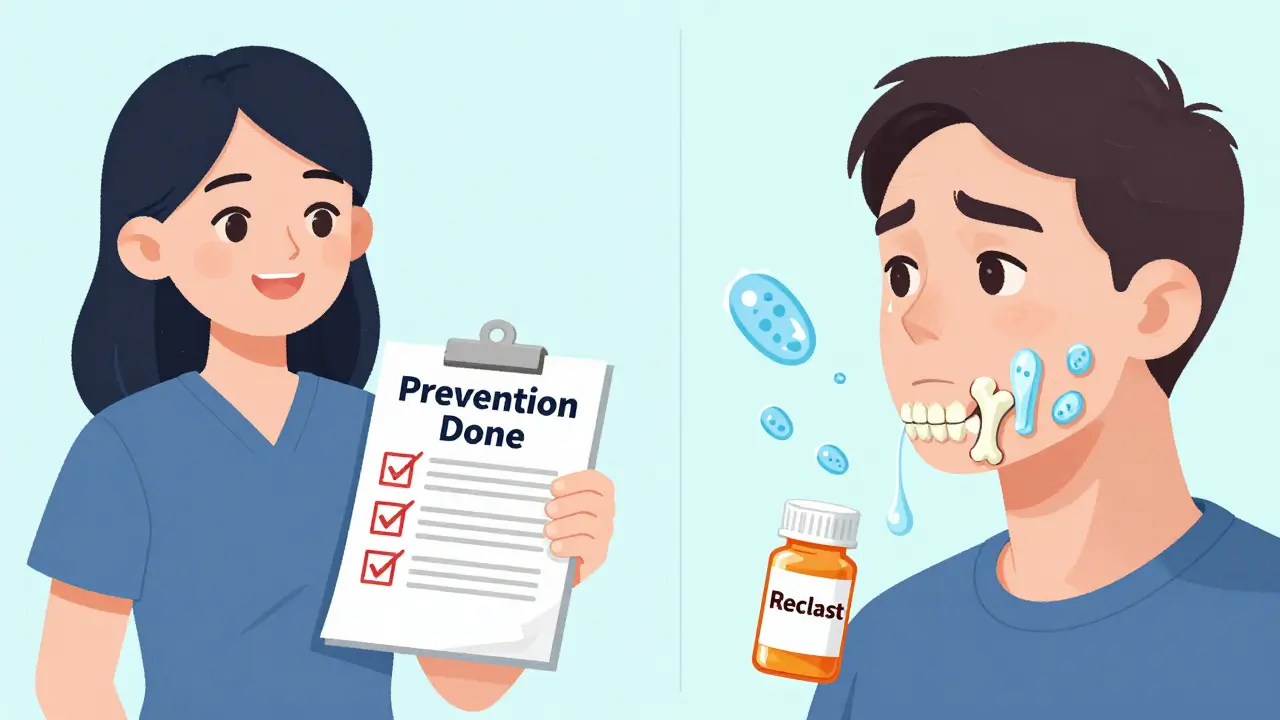
What If You Already Have It?
There’s no cure - but there’s hope. Early detection changes everything.
Stage 1: Exposed bone, no pain, no infection. Treatment? Antibiotics, mouth rinse, and monitoring. Many heal with time.
Stage 2: Exposed bone with pain and infection. Antibiotics, debridement (cleaning), and possibly stopping the drug temporarily.
Stage 3: Bone exposed, infection spreading, fractures, or fistulas. Surgery may be needed.
And here’s something new: teriparatide (Forteo), a bone-building drug, is showing promise. In early trials, 78% of stage 1 ONJ patients healed with it - compared to 32% with standard care. It’s not approved for ONJ yet, but it’s being tested.
Why Do So Many Miss the Signs?
Because doctors and dentists aren’t always talking to each other.
A 2023 survey found that 65% of cancer patients weren’t warned about dental risks before starting bisphosphonates. On patient forums, 73% said their dentist never asked about their osteoporosis meds. That’s a gap.
But it’s changing. In 2022, 87% of U.S. dental schools now teach about MRONJ - up from 42% in 2015. The FDA now requires warning labels on all these medications. And in 2023, the European Medicines Agency started requiring patient education materials to come with every prescription.
The message is clear: awareness saves jaws.
What’s Next?
Researchers are building tools to predict who’s at risk. The NIH-funded Osteonecrosis Prediction Algorithm (OPA) is in final testing. It will use your genetics, medication history, and dental status to give you a personalized risk score - by 2025.
For now, the best defense is simple:
- Know your meds.
- See your dentist before starting.
- Watch for signs - especially after dental work.
- Speak up if something feels off.
ONJ is rare. But it’s real. And if you’re on these drugs, your jaw is on the line. Don’t wait for bone to show. Act before it does.


Write a comment