

What Is Otitis Media?
Otitis media is an infection or inflammation of the middle ear, the space behind the eardrum that’s filled with air and connected to the throat by the Eustachian tube. It’s one of the most common reasons parents take their kids to the doctor - especially those under 3 years old. In fact, more than 80% of children will have at least one middle ear infection before their third birthday.
The problem starts when the Eustachian tube, which normally drains fluid and balances pressure, gets blocked. This happens after a cold, allergies, or a sinus infection. The tube swells shut, fluid builds up behind the eardrum, and bacteria or viruses - like Streptococcus pneumoniae, Haemophilus influenzae, or rhinovirus - start growing in that warm, wet pocket. That’s when pain, fever, and hearing trouble show up.
There are two main types: acute otitis media (AOM), which is the sudden, painful infection with fever and red, bulging eardrums, and otitis media with effusion (OME), where fluid stays behind the eardrum after the infection clears. OME doesn’t usually hurt, but it can muffle hearing for weeks or months. It doesn’t need antibiotics - it often goes away on its own.
Why Do Kids Get Ear Infections More Than Adults?
It’s mostly about anatomy. A child’s Eustachian tube is shorter, more horizontal, and floppier than an adult’s. That makes it harder for fluid to drain. Babies and toddlers also have weaker immune systems, and they’re often around other kids in daycare, where germs spread fast.
Other big risk factors include:
- Being exposed to cigarette smoke - it increases the chance of infection by about 50%
- Bottle-feeding while lying down - this lets milk or formula flow into the Eustachian tube
- Going to daycare - kids there get 2 to 3 times more ear infections
- Not being vaccinated - the pneumococcal vaccine (PCV13 or PCV15) cuts vaccine-type ear infections by up to 34%
Even something as simple as a family history of ear infections can make a child more prone. If your older child had frequent ear infections, your next one might too.
How Do Doctors Diagnose an Ear Infection?
It’s not just about a child crying or tugging at their ear. Those signs alone don’t mean infection. Many kids tug at their ears when they’re tired or teething.
A doctor uses a tool called a pneumatic otoscope - it’s a light with a little air puff. They look at the eardrum and gently squeeze air into the ear canal. If the eardrum moves easily, it’s likely fine. If it’s red, swollen, and doesn’t move, that’s a classic sign of AOM. The eardrum might even look bulging or have a yellow or white spot.
In some clinics, they now use tympanometry, a quick test that measures how the eardrum responds to pressure changes. A 2023 study in Pediatrics found that using this tool in offices reduced unnecessary antibiotic prescriptions by 22% in kids under 3.
For kids with recurring infections or hearing concerns, an audiologist might do a hearing test. During an active infection, hearing can drop 15 to 40 decibels - enough to make voices sound muffled, like underwater.
When Should Antibiotics Be Used?
This is where things get tricky - and why so many parents are confused. The truth? Most ear infections get better without antibiotics. About 80% of kids with mild to moderate AOM will recover in 2 to 3 days with just pain relief.
The American Academy of Pediatrics and the American Academy of Family Physicians say antibiotics should be used when:
- The child is under 6 months old and has a confirmed infection
- The child is 6 to 23 months old with severe symptoms - fever over 102.2°F or ear pain lasting more than 48 hours
- The child is 2 years or older with severe pain or high fever
- The child has a history of frequent infections or other health problems that make them more vulnerable
For most healthy kids over 2 with mild symptoms, doctors recommend watchful waiting. That means giving pain medicine for 48 hours and seeing if things improve. If not, then start antibiotics.
Studies show this approach works. Parents on Reddit’s r/Parenting shared stories like: “We waited 48 hours. The fever broke. The crying stopped. No antibiotics needed - and no diarrhea from amoxicillin.”

Which Antibiotics Are Used, and How Long Do You Take Them?
If antibiotics are needed, amoxicillin is the first choice. It’s cheap, effective, and safe. The dose is 80-90 mg per kilogram of body weight per day, split into two doses. For example, a 20-pound (9 kg) child would get about 720-810 mg daily, divided into two doses.
Here’s the standard treatment duration based on age and severity:
- Under 2 years: 10 days
- 2 to 5 years with severe symptoms: 7 days
- 6 years and older with mild symptoms: 5 to 7 days
If your child is allergic to penicillin, alternatives include:
- Cefdinir (oral, once daily)
- Ceftriaxone (single shot in the doctor’s office)
- Azithromycin (5-day course)
But here’s the catch: antibiotic resistance is rising. About 30-50% of Streptococcus pneumoniae strains in the U.S. are resistant to regular-dose penicillin. That’s why high-dose amoxicillin is now the standard - it still works against most resistant strains. Even so, resistance in Haemophilus influenzae to amoxicillin-clavulanate (Augmentin) has jumped from 7.2% in 2010 to 12.4% in 2022.
That’s why doctors are moving away from using Augmentin as a first-line drug unless the infection doesn’t improve with amoxicillin.
What About Pain Relief?
Pain control isn’t optional - it’s the top priority. A child in pain can’t sleep, eat, or calm down. That’s why doctors stress giving pain medicine before deciding on antibiotics.
Use either:
- Acetaminophen - 10-15 mg per kg every 4-6 hours
- Ibuprofen - 5-10 mg per kg every 6-8 hours
Many parents say ibuprofen works better for ear pain because it reduces inflammation too. One parent on r/TwoXChromosomes wrote: “Ibuprofen every 6 hours made the difference between screaming all night and finally sleeping.”
You can also use a warm washcloth pressed gently against the ear. Some doctors recommend otic analgesic drops like Auralgan - but never use them if you suspect the eardrum has ruptured (you’ll see pus or blood draining from the ear).
Red Flags That Need Immediate Care
Most ear infections are mild. But watch for these signs - they mean you need to go back to the doctor or to urgent care:
- Fever over 104°F that doesn’t come down with medicine
- Severe ear pain that doesn’t improve after 48 hours of pain relief
- Pus or blood draining from the ear - this means the eardrum may have burst
- Dizziness, trouble walking, or facial drooping - signs the infection may have spread
- Swelling behind the ear - could mean mastoiditis, a serious complication
One parent in Ohio shared a scary story: “After 72 hours of waiting, my 2-year-old spiked 104°F and ended up in the ER with a ruptured eardrum. I wish we’d started antibiotics sooner.”
That’s the tough part - there’s no perfect rule. Some kids get worse fast. Others improve slowly. Trust your instincts. If your child looks sicker, doesn’t improve, or you’re just worried - call the doctor. Don’t wait.
What About Recurrent Ear Infections?
One in five kids has three or more ear infections in six months. That’s called recurrent AOM. It’s frustrating - for parents and kids. Repeated antibiotics mean more diarrhea, rashes, and concern about long-term resistance.
For these kids, doctors may recommend:
- Ear tubes (tympanostomy tubes) - tiny plastic tubes placed in the eardrum to drain fluid and prevent buildup
- More aggressive vaccination - ensuring they’re up to date on PCV15 and flu shots
- Checking for allergies or enlarged adenoids - both can block the Eustachian tube
Ear tubes don’t cure infections, but they help reduce how often they happen. Most tubes fall out on their own in 6 to 12 months. The procedure is quick, done under light anesthesia, and kids usually go home the same day.
What’s New in Treatment?
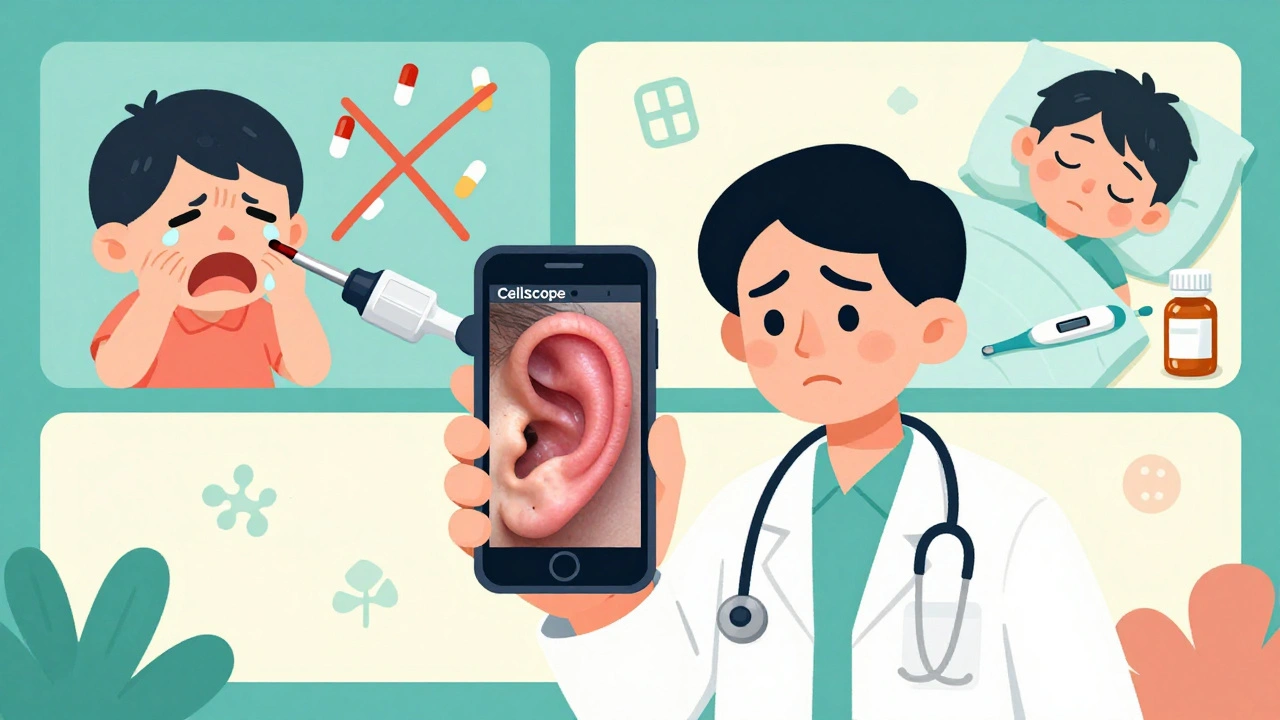
Technology is changing how we manage ear infections. The FDA cleared the CellScope Oto - a smartphone attachment that lets parents take pictures of the eardrum and send them to the doctor. Studies show it’s 85% accurate compared to in-person exams. That’s huge for families in rural areas or those who can’t get a same-day appointment.
There’s also talk about point-of-care bacterial tests - quick lab tests that can tell if the infection is bacterial or viral within minutes. Dr. Peter Roland at UT Southwestern says these could cut unnecessary antibiotic use by 30-40% within five years.
And while probiotics were once thought to help prevent ear infections, a 2022 Cochrane review of 13 studies found no real benefit. So skip the gummies - focus on vaccines and avoiding smoke.
What You Can Do at Home
- Keep your child upright during feeding - this helps prevent fluid from backing into the ear
- Avoid smoke exposure - even secondhand smoke increases risk
- Keep up with vaccines - PCV15 and flu shots are your best defense
- Use pain medicine as directed - don’t wait until the child is screaming
- Track symptoms - note fever, pain level, sleep, and eating habits. This helps your doctor decide if antibiotics are needed
And remember: fluid behind the eardrum after an infection? That’s OME. It’s not an infection. It doesn’t need antibiotics. It usually clears in 3 months. Don’t rush to treat it - just monitor.
Why This Matters Beyond the Ear
Otitis media isn’t just a childhood nuisance. In the U.S., it leads to 15.5 million doctor visits every year. The cost? Over $2.89 billion. And about 15 million antibiotic prescriptions are written for ear infections - making it the second most common reason kids get antibiotics, right after sore throats.
Every time we give an antibiotic when it’s not needed, we make it harder to treat serious infections later. That’s why the CDC calls penicillin-resistant pneumococcus a “serious threat.”
Choosing to wait - when appropriate - isn’t being lazy. It’s being smart. It’s protecting your child’s health and the health of everyone around them.
Do all ear infections need antibiotics?
No. About 80% of mild to moderate ear infections in children over 2 years old clear up on their own within 2 to 3 days. Pain relief and observation are often the best first steps. Antibiotics are reserved for severe cases, very young children, or if symptoms don’t improve after 48 hours.
Can ear infections cause hearing loss?
Yes, temporarily. During an active infection, fluid behind the eardrum can cause conductive hearing loss of 15 to 40 decibels - enough to make speech sound muffled. This usually goes away once the infection clears. But if fluid stays for months (OME), especially in young kids learning to speak, it can delay language development. That’s why persistent fluid is monitored closely.
Is it safe to use ear drops for ear pain?
Otic analgesic drops like Auralgan can help relieve pain - but only if the eardrum is intact. Never use them if you see pus, blood, or fluid draining from the ear. That means the eardrum may be ruptured, and drops could cause further irritation or infection. Always check with your doctor before using them.
Why is amoxicillin the first choice for ear infections?
Amoxicillin is effective against the most common bacteria causing ear infections - especially at high doses (80-90 mg/kg/day). It’s safe, affordable, and has fewer side effects than alternatives. Even with rising resistance, high-dose amoxicillin still works for most cases. Augmentin is usually saved for when amoxicillin fails.
Can ear infections be prevented?
Yes, significantly. Vaccines like PCV15 and the flu shot reduce risk by up to 34%. Breastfeeding in an upright position, avoiding smoke exposure, and limiting daycare exposure in the first year also help. While probiotics don’t seem to help, good hygiene and avoiding pacifier use after 6 months can reduce frequency in some kids.
What should I do if my child’s ear infection doesn’t improve?
If symptoms don’t improve after 48 hours of pain medicine, or if they get worse - fever spikes, pus drains from the ear, or your child seems unusually lethargic - contact your doctor immediately. You may need a different antibiotic or further testing. Don’t wait too long if you’re worried - early intervention prevents complications.
Final Thoughts
Ear infections are common, but they’re not always serious. The biggest mistake isn’t waiting too long - it’s treating every case like an emergency. Antibiotics save lives, but they’re not magic. They come with risks: diarrhea, rashes, allergic reactions, and long-term resistance.
For most kids, the best treatment is comfort, patience, and close observation. For others, antibiotics are necessary - and lifesaving. The key is knowing the difference. Trust your doctor, trust your instincts, and don’t feel guilty for asking questions. Your child’s ear health matters - and so does the future of antibiotics.


Write a comment