
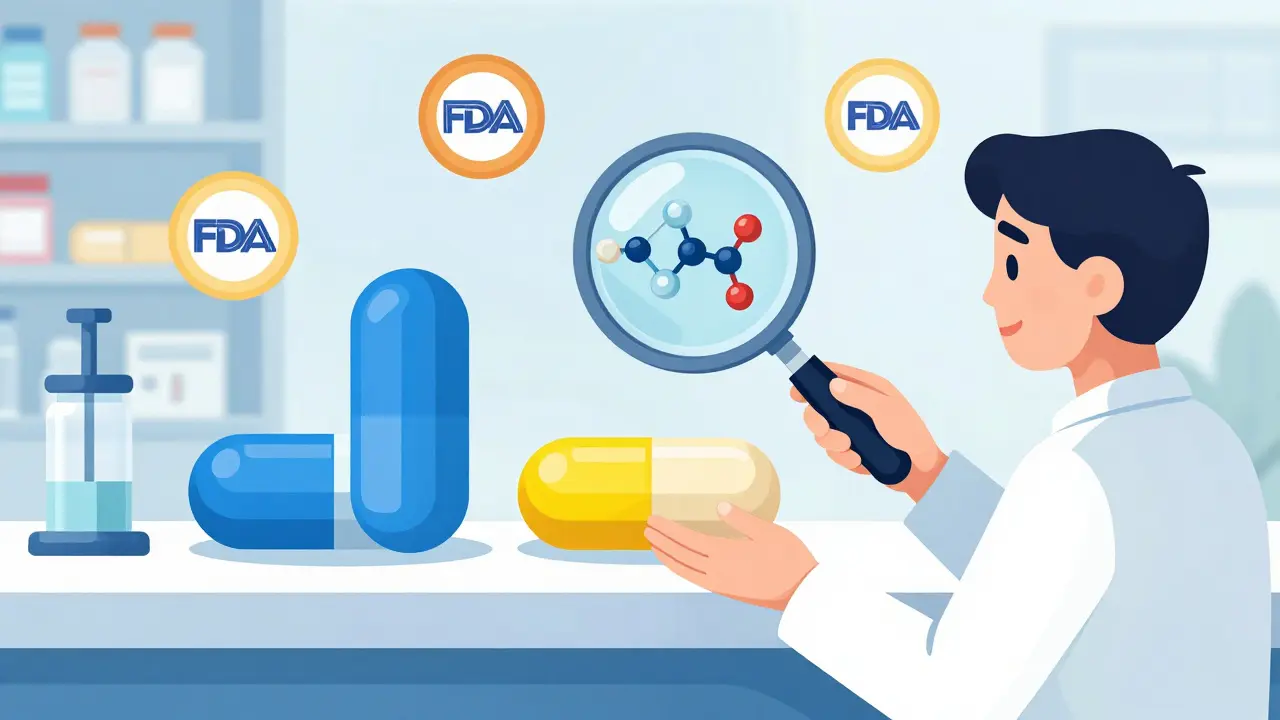
When you pick up a prescription and see a generic drug instead of the brand-name version, you might wonder: Is this really the same thing? It’s a fair question. After all, the pill looks different. The name is different. And it costs way less. But here’s the truth: if it meets pharmaceutical equivalence standards, it’s not just similar-it’s the same in the most important way.
What pharmaceutical equivalence actually means
Pharmaceutical equivalence isn’t marketing jargon. It’s a strict, science-based definition used by the U.S. Food and Drug Administration (FDA). A generic drug is considered pharmaceutically equivalent to its brand-name counterpart if it has the exact same active ingredient, in the same amount, delivered the same way. That means the same chemical compound, same dosage form (tablet, capsule, injection), same strength, and same route of administration (oral, topical, IV, etc.).For example, if you’re prescribed 20 mg of omeprazole in a capsule, the generic version must contain 20 mg of omeprazole in a capsule. No more. No less. The FDA requires manufacturers to prove this using high-performance liquid chromatography (HPLC), a lab technique that measures the exact amount of active ingredient in each batch. The acceptable range? Within ±5% of the labeled amount. That’s tight.
But here’s what pharmaceutical equivalence doesn’t require: the same color, shape, taste, or inactive ingredients. That’s why your generic pill might be blue instead of yellow, or oval instead of round. The fillers, binders, and coatings-called excipients-can be different. And that’s okay, as long as they don’t change how the drug works.
Why pharmaceutical equivalence matters
This standard exists because of the Hatch-Waxman Act of 1984. Before that, generic drugs faced huge barriers. Companies had to run full clinical trials just to prove their drug worked-costing millions and taking years. The law changed that. It said: if you can prove your drug is pharmaceutically equivalent, you don’t need to repeat every clinical trial the brand-name company did.That’s how we got to where we are today: 90% of all prescriptions in the U.S. are filled with generics. And those generics saved the healthcare system over $2.2 trillion between 2009 and 2023. That’s not just savings-it’s access. People who couldn’t afford brand-name drugs can now take them.
But pharmaceutical equivalence is only the first step. It’s the foundation. Think of it like building a house. You need the right bricks, nails, and beams-that’s pharmaceutical equivalence. But you also need to make sure the house doesn’t leak, the doors swing right, and the heat stays in. That’s where bioequivalence comes in.
Pharmaceutical vs. bioequivalence: the difference that matters
Many people confuse pharmaceutical equivalence with bioequivalence. They’re not the same.Pharmaceutical equivalence says: “Same active ingredient, same amount, same form.”
Bioequivalence says: “Does the body absorb and use it the same way?”
To prove bioequivalence, manufacturers run studies with healthy volunteers. They measure how much of the drug enters the bloodstream and how fast. The generic must deliver between 80% and 125% of the brand-name drug’s amount in the blood over time. That’s not a loophole-it’s a scientifically accepted range that accounts for normal human variation in digestion, metabolism, and absorption.
Dr. Janet Woodcock, former head of the FDA’s drug center, put it simply: “Pharmaceutical equivalence ensures the same active ingredient in the same amount. Bioequivalence ensures it gets to the site of action in the same way.”
For most drugs, this range works perfectly. But for some, it’s a bigger deal. Take warfarin, a blood thinner. Even a small change in how much of the drug gets into the blood can lead to dangerous clots or bleeding. That’s why the FDA watches these drugs extra closely-even if they’re pharmaceutically and bioequivalent, doctors sometimes prefer to stick with one brand.

What about therapeutic equivalence?
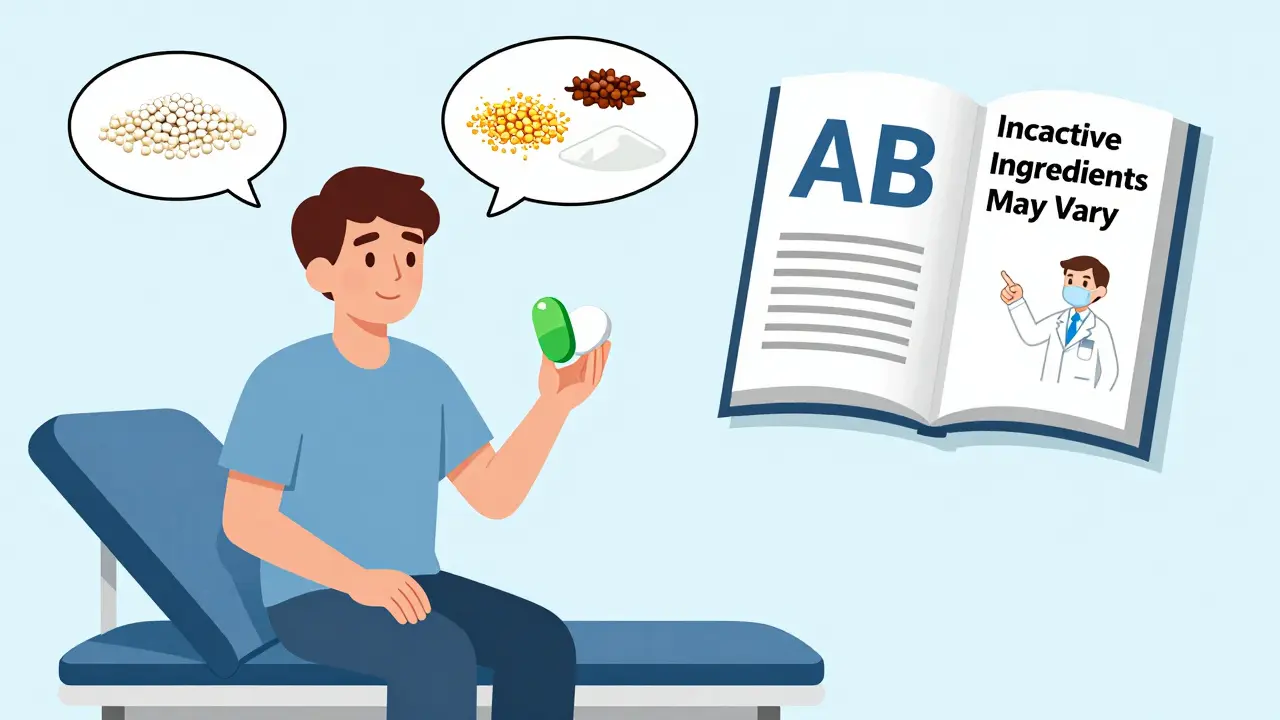
Therapeutic equivalence is the final layer. It means: “You can switch between this generic and the brand name without any change in how well it works or how safe it is.”The FDA rates every approved drug in its “Orange Book.” If a generic is rated “AB,” it means it’s pharmaceutically equivalent, bioequivalent, and therapeutically equivalent. You can swap it freely. If it’s rated “BX,” there’s a reason-maybe the drug is too complex, or there’s not enough data to confirm it works the same in real patients.
As of June 2024, there were 15,372 approved generic drugs in the U.S. Of those, 12,845 were rated “AB.” That’s over 83% of generics you’ll see on the shelf. The rest? They’re either new, complex, or still under review.
What you might not know: excipients and patient reactions
Even though excipients don’t affect the drug’s main action, they can still matter. Some people are sensitive to dyes, gluten, lactose, or certain preservatives. A 2022 survey found that 87% of pharmacists have had at least one patient report a side effect-like a rash, stomach upset, or headache-after switching to a generic, mostly because of these inactive ingredients.Only 2.3% of those cases required switching back to the brand. But for patients with allergies or conditions like celiac disease, even that small percentage matters. That’s why the American Society of Health-System Pharmacists is pushing for clearer labeling of excipients. Right now, you have to dig through the package insert. That’s not user-friendly.
And here’s a myth that still circulates: “Generics only have 80% of the active ingredient.” That’s not true. The 80-125% range applies to how much gets into your blood-not how much is in the pill. The pill itself always has the exact amount stated on the label.
What this means for you as a patient
If you’re prescribed a generic drug rated “AB,” you can trust it. It’s been tested, reviewed, and approved to work just like the brand name. The FDA doesn’t cut corners. The same quality controls apply.But if you’ve had a bad reaction after switching-whether it’s a weird taste, a rash, or feeling off-you’re not imagining it. Talk to your pharmacist. Ask if the excipients changed. Sometimes, switching to a different generic version (even another “AB” rated one) helps.
Don’t assume all generics are identical. Two different companies can make two different versions of the same drug. One might use cornstarch. Another might use tapioca. One might have a coating that dissolves faster. For most people, it doesn’t matter. For some, it does.
What’s changing in the future
The FDA is updating its standards for complex drugs-things like inhalers, injectables, and topical creams. These aren’t simple pills. Their delivery systems matter. A generic inhaler might have the same active ingredient, but if the propellant or nozzle design is different, it might not deliver the same dose to your lungs.That’s why the FDA launched its Complex Generic Drug Product Development program in 2023. They’re investing $15 million into new testing methods like Raman spectroscopy and X-ray diffraction to better analyze these products. By 2027, we’ll likely see stricter equivalence rules for these types of drugs.
For now, if you’re taking something like glatiramer acetate (used for multiple sclerosis) or an asthma inhaler, your doctor might still recommend sticking with the same brand or generic version. Don’t switch without talking to them.
Bottom line: Trust the system-but stay informed
Pharmaceutical equivalence is one of the most successful public health policies in modern medicine. It’s not perfect, but it’s rigorously tested. Generics are safe, effective, and save billions every year.You don’t need to fear generics. You just need to know what you’re taking. Check the Orange Book rating. Ask your pharmacist if the excipients changed. If you feel different after switching, speak up. And remember: the goal isn’t to find the cheapest pill. It’s to find the right one-for your body, your health, and your life.
Are generic drugs as strong as brand-name drugs?
Yes. Generic drugs must contain the exact same amount of active ingredient as the brand-name version, within a ±5% tolerance. The FDA requires lab testing to confirm this before approval. The difference isn’t in strength-it’s in cost.
Why do generic pills look different from brand-name ones?
By law, generics can’t look identical to brand-name drugs to avoid trademark infringement. That’s why color, shape, and size can differ. But the active ingredient, strength, and how it works in your body are the same. The differences are only in inactive ingredients like dyes or fillers.
Can I switch between different generic brands?
If both are rated "AB" by the FDA, you can. But some people notice minor differences in side effects due to changes in inactive ingredients. If you switch and feel unwell, talk to your pharmacist. You might need to stick with one generic version.
Are there generics that aren’t safe to use?
All FDA-approved generics are safe. But some are rated "BX" or "BZ," meaning they’re not considered therapeutically equivalent. These are usually complex drugs like inhalers or biologics where small differences matter. Always check the Orange Book rating or ask your pharmacist before switching.
Do generics take longer to work than brand-name drugs?
No. Bioequivalence testing ensures that generics enter your bloodstream at the same rate and to the same extent as the brand-name drug. If you feel a delay, it’s likely due to your body’s natural variation-not the drug. But if you’re on a narrow therapeutic index drug like warfarin, always monitor your response with your doctor.
If you’re on a long-term medication and your pharmacy switches your generic without telling you, ask why. You have the right to know. And if you’re unsure, ask for the Orange Book rating. It’s public information-and it’s your best tool for making smart, confident choices about your health.


Write a comment