
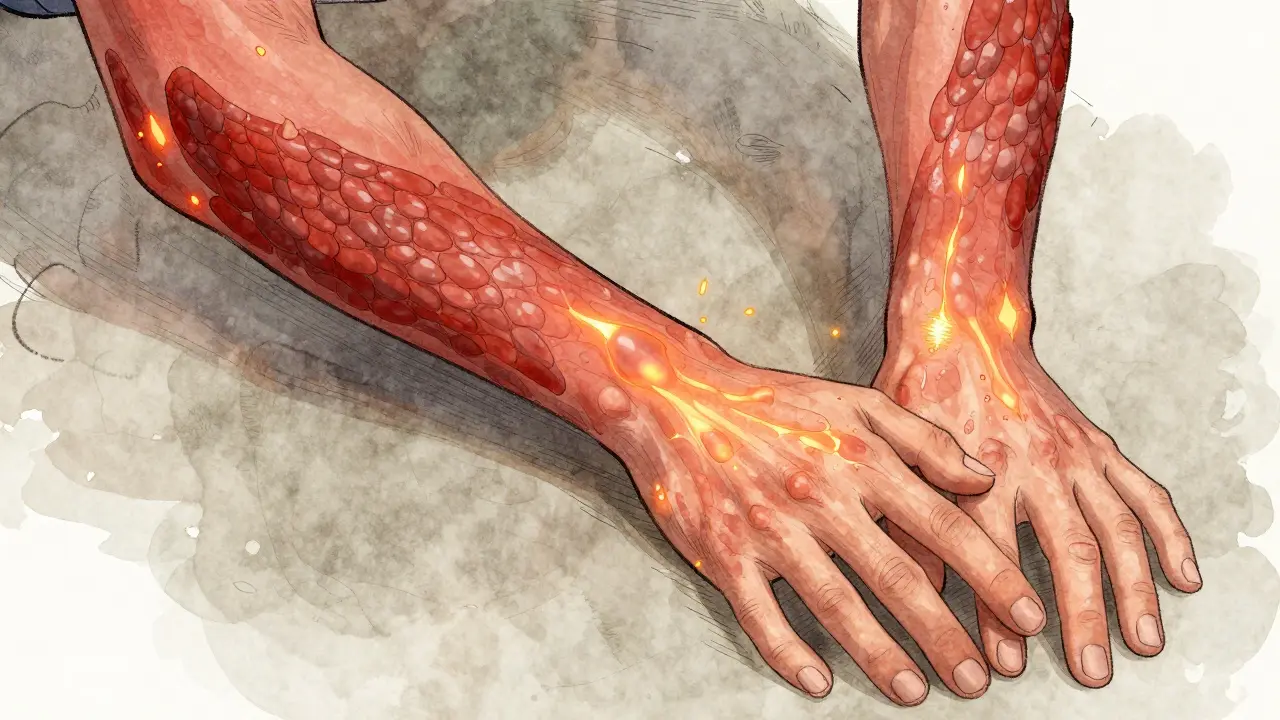
When your skin flares with red, scaly patches, it’s easy to think the problem stops there. But for about 1 in 3 people with psoriasis, the real trouble is hiding in the joints. Psoriatic arthritis isn’t just a side effect-it’s a full-blown autoimmune disease that attacks both skin and joints, often without warning. This isn’t ordinary arthritis. It doesn’t come from aging or overuse. It comes from your immune system turning on itself.
It Starts with Skin, But Doesn’t Stay There
Psoriasis usually shows up first. You notice patches on your elbows, knees, or scalp. Maybe you’ve had it for years. Then, out of nowhere, your fingers swell. Your heels hurt when you walk. Your lower back stiffens up in the morning. That’s not coincidence. It’s psoriatic arthritis (PsA) waking up.Most people develop joint symptoms 5 to 10 years after skin psoriasis starts. But here’s the twist: in about 15% of cases, the joints hurt before the skin ever breaks out. That’s why so many patients go years undiagnosed. Doctors see swollen fingers and assume gout or rheumatoid arthritis. They don’t connect the dots until they spot the tiny pits in the fingernails-the same nails that are also flaking or lifting off the nail bed.
Nail changes are a huge clue. Eight out of ten PsA patients have them. Pitting, thickening, discoloration, separation from the nail bed. These aren’t just cosmetic. They’re signs of inflammation deep in the tissue beneath the nail. And if you see them, especially with joint pain, you’re looking at PsA.
The Five Faces of Psoriatic Arthritis
PsA doesn’t look the same in everyone. It comes in five distinct patterns, and knowing which one you have helps guide treatment.- Asymmetric oligoarthritis-This is the most common. It hits a few joints, but not the same ones on both sides. Think: left knee and right wrist. It’s unpredictable, which makes it harder to spot.
- Symmetric polyarthritis-This one mimics rheumatoid arthritis. Joints on both sides swell: both hands, both ankles. But unlike RA, the blood tests for rheumatoid factor come back negative. That’s a key difference.
- Distal interphalangeal predominant (DIP)-This targets the joints closest to your fingernails. It’s rare in other types of arthritis, so if your fingertips are inflamed and your nails are messed up, PsA is likely.
- Spondylarthritis-This affects the spine and sacroiliac joints. You feel stiffness in your lower back that gets worse with rest and better with movement. It’s often mistaken for regular back pain or sciatica.
- Arthritis mutilans-The rarest and most severe. It eats away at bone, causing fingers or toes to shorten and look like they’re melting. It’s called the ‘opera glass hand’ because the digits collapse inward.
Most people have one main pattern, but some mix symptoms. That’s why PsA is so tricky to diagnose.
What Makes PsA Different from Other Arthritis
Osteoarthritis? That’s wear and tear. Your cartilage breaks down. No immune system involved. Rheumatoid arthritis? It’s autoimmune too-but it targets the lining of the joints symmetrically and shows up in blood tests. PsA? It’s a wildcard.Here’s what sets PsA apart:
- Dactylitis-Whole fingers or toes swell up like sausages. That’s not just joint swelling. It’s inflammation in the tendons and ligaments too. About half of PsA patients get this.
- Enthesitis-Inflammation where tendons or ligaments attach to bone. Common spots: the back of the heel (Achilles tendon) and the bottom of the foot (plantar fascia). Walking feels like stepping on glass.
- Pencil-in-cup deformities-On X-rays, bones in the fingers start to erode unevenly. One side looks like a sharpened pencil, the other like a cup. It’s unique to PsA.
- Periostitis-New bone forms around tendons like whiskers. That’s a telltale sign you won’t see in RA or OA.
And here’s the kicker: 68% of PsA patients have other issues too. Eye inflammation (uveitis). Inflammatory bowel disease. Fatigue so deep it feels like you’re dragging concrete. These aren’t random. They’re part of the same immune fire.
Why Diagnosis Takes So Long
The average patient sees three doctors before getting diagnosed. It takes 2 to 5 years. Why?Because psoriasis and arthritis are treated by different specialists. Dermatologists focus on skin. Rheumatologists focus on joints. Neither one always asks about the other. A patient with swollen fingers might go to a hand specialist, then an orthopedist, then a rheumatologist. By then, damage is done.
One Reddit user wrote: ‘I had 18 months of joint pain before my rheumatologist connected my nail pitting to my skin patches. By then, I had permanent damage in three fingers.’
Doctors who know PsA look for the combo: nail changes + dactylitis. Together, they’re 89% specific for PsA. That’s a powerful clue. But most primary care doctors don’t know this.
Triggers and Risk Factors You Can’t Ignore
You can’t change your genes. But you can change what lights the fire.- Stress-Cited by 85% of patients as a flare trigger. It’s not ‘all in your head.’ Stress hormones directly fuel inflammation.
- Infections-Strep throat, flu, even a bad cold can spark PsA in someone genetically prone. The immune system gets confused and starts attacking healthy tissue.
- Obesity-A BMI over 30 triples your risk. Fat isn’t just storage. It’s active tissue that pumps out inflammatory chemicals.
- Joint trauma-If you’ve injured a joint, PsA is 4 times more likely to develop there. It’s called the Koebner phenomenon: injury triggers psoriasis in that exact spot.
- Cold weather-57% of patients report worse symptoms in winter. Dry air, less movement, reduced sunlight-all help inflammation grow.
These aren’t myths. They’re documented in patient registries and clinical studies. Managing them isn’t optional-it’s part of treatment.
Treatment: Early Action Saves Joints
The biggest mistake? Waiting. Every month you delay treatment, you lose more joint structure.Studies show: if you start biologic drugs within 6 months of symptoms, you cut joint damage by 73% over two years. Wait longer? The damage piles up.
Here’s what works:
- DMARDs-Methotrexate is still used in 65% of cases. It slows disease, but doesn’t stop it fast enough for many.
- TNF inhibitors-Drugs like adalimumab or etanercept. They work well-65% of patients reach minimal disease activity in 6 months.
- IL-17 and IL-23 inhibitors-Newer drugs like secukinumab or guselkumab. They target specific immune pathways. In trials, 64% of patients saw major improvement in joint pain within 6 months.
But here’s the hard truth: 30% of people don’t respond to first-line biologics. That’s why treatment isn’t one-size-fits-all. You might need to try two or three before finding what works.
And yes, there are risks. JAK inhibitors carry a slightly higher chance of heart problems or cancer. That’s why they’re not first-line anymore. Your doctor should weigh benefits against risks-especially if you smoke, have high blood pressure, or are over 50.

Integrated Care Is the Only Way Forward
You need two specialists working together: a dermatologist and a rheumatologist. Not one, then the other. Together.Studies show 82% of patients with optimal outcomes get care from both. Only 54% do well with one specialist alone. Why? Because skin and joints are connected. A flare in one often means a flare in the other. A change in medication for your skin might affect your joints. And vice versa.
Doctors who treat PsA use tools to track progress:
- MASES-Measures enthesitis at 14 key sites.
- Dactylitis Count-Numbers how many sausage digits you have.
- NAPSI-Scores nail damage on a scale from 0 to 100.
These aren’t just checklists. They’re metrics. They tell you if your treatment is working-or if you need to switch.
What’s Next? Personalized Treatment Is Coming
By 2027, treatment won’t be based on trial and error. It’ll be based on your genes, your proteins, your immune profile.Researchers are already testing blood tests that predict who will respond to IL-17 inhibitors versus TNF blockers. One study found that certain immune markers could predict response with over 80% accuracy. That’s huge. It means you won’t waste months on a drug that won’t work for you.
And it’s not just drugs. Lifestyle matters more than ever. Weight loss, even 10%, cuts inflammation. Exercise improves joint function. Sunlight (or vitamin D) helps regulate immune response. Quitting smoking? That alone lowers flare risk by nearly half.
The message is clear: PsA isn’t just a joint disease. It’s a whole-body condition. Ignoring the skin? You’re ignoring half the battle. Ignoring the joints? You’re risking permanent damage.
What You Can Do Today
If you have psoriasis and any joint pain, stiffness, or swelling-don’t wait. See a rheumatologist. Bring your skin history. Point out nail changes. Mention fatigue. Don’t let anyone tell you it’s ‘just aging’ or ‘overuse.’If you’ve been diagnosed:
- Track your symptoms. Use a journal or app. Note what triggers flares.
- Get regular X-rays or ultrasounds. Early damage is reversible. Late damage isn’t.
- Work with both a dermatologist and rheumatologist. Don’t let them work in silos.
- Manage stress. Try yoga, meditation, or even walking 30 minutes a day.
- Watch your weight. Even a little loss helps.
Psoriatic arthritis doesn’t have to be a life sentence. But it demands attention. Early, consistent, and coordinated. Your skin and your joints are speaking the same language. You just need to listen.


Write a comment