
QT Interval Calculator
Calculate your corrected QT interval (QTc) to understand cardiac safety risk from medications or conditions that may prolong QT. This tool uses the Bazett formula (QTc = QT / √RR) and is for educational purposes only.
Important Note: This calculator is for educational purposes only and should not be used as a medical diagnostic tool. QTc values are used by healthcare professionals to assess cardiac risk, but interpretation requires clinical context. Consult your doctor for medical advice and never rely on this tool for emergency situations. For patients on QT-prolonging medications, wearables like Apple Watch or KardiaMobile are tools for monitoring, not diagnosis. If you experience chest pain, dizziness, or palpitations, seek immediate medical attention.
When your heart’s electrical rhythm goes off-track, it doesn’t always scream for help. Sometimes, it whispers - a subtle delay in the QT interval that can quietly raise your risk of sudden cardiac arrest. For patients on medications like certain antibiotics, antipsychotics, or antiarrhythmics, this delay can be life-threatening. Until recently, catching it meant frequent clinic visits, bulky Holter monitors, or waiting for symptoms to become severe. Now, a quiet revolution is happening in your pocket - wearable ECGs are making real-time QT safety monitoring possible, even at home.
What Is the QT Interval, and Why Does It Matter?
The QT interval is the time it takes for your heart’s ventricles to recharge between beats. It’s measured on an ECG from the start of the Q wave to the end of the T wave. If it’s too long - a condition called QT prolongation - your heart can slip into a dangerous rhythm called torsades de pointes, which can turn into sudden cardiac death. This isn’t rare. About 1 in 2,000 people on QT-prolonging drugs experience this. And for those with genetic long QT syndrome, the risk is even higher.
Doctors have always monitored QT intervals with 12-lead ECGs in clinics. But those are snapshots. What if your QT prolongation only shows up after you take your evening pill? Or during sleep? That’s where wearable ECGs change everything.
How Wearable ECGs Measure QT Intervals
Not all smartwatches can measure QT. Only a few devices have been clinically validated and cleared by the FDA for this specific use. The two most studied are the Apple Watch Series 4 and later, and the KardiaMobile 6L from AliveCor.
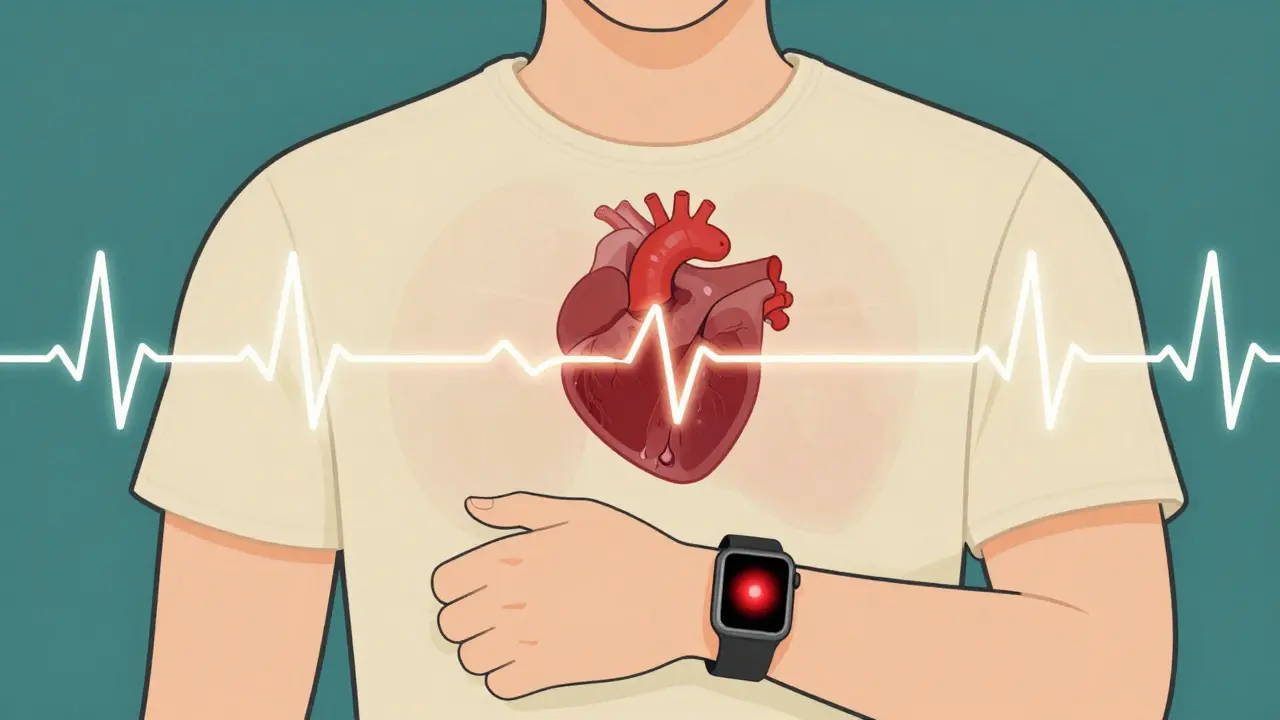
The Apple Watch uses a single-lead ECG. You touch the digital crown for 30 seconds, and it records your heart’s electrical activity through your fingers. It’s not a full 12-lead ECG, but research from Spaccarotella et al. (2021) showed it matches standard ECGs within 90% accuracy for QT measurements - especially when averaged across leads. Its strength? Accessibility. You can check your QT anytime, anywhere.
The KardiaMobile 6L is a handheld device, about the size of a credit card. It has electrodes on both top and bottom. You place your thumbs on the top, and your left ankle or knee on the bottom. This creates a 6-lead ECG - more like a hospital-grade reading. Studies show its QT measurements are nearly identical to standard 12-lead ECGs, with differences under 20 milliseconds. That’s within clinical tolerance.
Both devices use Bluetooth to send data to a phone app. The app doesn’t just show a waveform - it calculates the corrected QT interval (QTc), adjusting for your heart rate. That’s critical. A long QT at a slow heart rate is more dangerous than one at a fast one.
When This Technology Became a Lifesaver
The real turning point came in 2020. During the pandemic, hospitals were overwhelmed. Patients with COVID-19 were being treated with drugs like hydroxychloroquine and azithromycin - both known to prolong the QT interval. Many couldn’t come in for daily ECGs. So the FDA stepped in. In April 2020, it issued emergency guidance allowing the use of KardiaMobile 6L and similar devices to monitor QT intervals remotely.
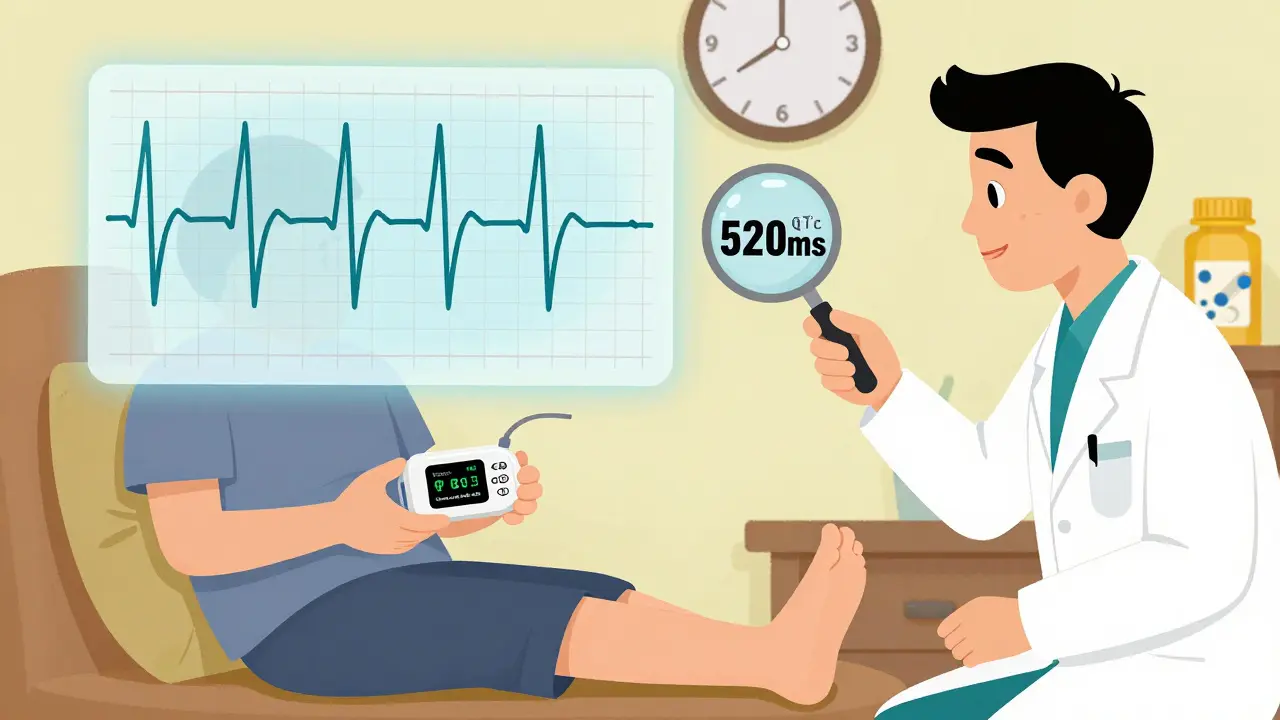
That same year, Dr. Jason Chinitz published a case report in Innovations in Cardiac Rhythm Management showing how an Apple Watch caught dangerous QT prolongation in a patient on these drugs. The patient’s QTc jumped from 440ms to 520ms - a clear red flag. Without the watch, it might have gone unnoticed until cardiac arrest.
That moment changed everything. Suddenly, wearable ECGs weren’t just fitness gadgets. They became medical tools.
Limitations You Can’t Ignore
Wearables aren’t perfect. They’re not designed to replace full 12-lead ECGs in emergencies. Their biggest weakness? Signal quality. Skin-to-electrode impedance - basically, how well the sensor sticks to your skin - can mess up readings. Sweat, dry skin, or improper placement can cause noise. That’s why the KardiaMobile 6L requires you to press your ankle against the device. The Apple Watch needs you to hold your finger firmly on the crown.
Also, these devices aren’t good at detecting other problems. A 2023 study found they miss over 79% of pathologic Q waves - signs of prior heart attacks. They’re great for QT and atrial fibrillation. Not so much for ischemia or heart block.
And here’s the catch: no consumer device has a built-in, FDA-approved algorithm that automatically flags dangerous QT prolongation. The apps show the number, but you - or your doctor - still have to interpret it. That’s why some experts say these tools are best for monitoring trends, not making single-point diagnoses.
AI Is Making the Next Leap
The next big thing? Artificial intelligence. Researchers at Stanford and elsewhere are training deep learning models to read single-lead ECGs and predict QT prolongation without human input.
In 2024, a team led by Alam et al. built a neural network that analyzed just two beats from a single-lead ECG - the kind your Apple Watch records - and predicted if QTc was above 500ms with 92% accuracy. They tested it on 686 patients with genetic heart conditions. The model didn’t just match human experts - it outperformed them in speed and consistency.
This matters because right now, thousands of wearable ECG recordings pile up in clinics. Cardiologists can’t review them all in time. AI can. Imagine a system that alerts your doctor the moment your QTc crosses 500ms - while you’re still asleep. That’s the future. And it’s already being tested in clinical trials.
How This Is Changing Clinical Trials
Pharmaceutical companies are using wearable ECGs in drug trials more than ever. Before, they relied on periodic clinic ECGs. Now, they give patients KardiaMobile 6L devices to use daily during drug loading. The result? More data, fewer dropouts, and faster results.
Applied Clinical Trials reported in 2023 that wearable ECGs reduce trial costs by up to 30% and cut monitoring time by half. They also improve compliance - patients are more likely to use a device they can carry in their pocket than wear a bulky Holter monitor for 48 hours.
AliveCor alone has received 16 FDA clearances for its devices, including QT monitoring. That’s not an accident. It’s evidence that regulators see this as legitimate medical tech.
Who Should Use It - and Who Shouldn’t
Wearable ECGs for QT monitoring are best for:
- Patients on medications known to prolong QT (e.g., ciprofloxacin, haloperidol, amiodarone)
- People with inherited long QT syndrome
- Those recovering from cardiac events and starting new drugs
- Clinical trial participants needing frequent cardiac safety checks
They’re not for:
- People with no risk factors - no need to monitor if you’re not on risky meds
- Those with irregular heart rhythms like frequent PVCs - these can confuse QT measurements
- Anyone who can’t follow instructions (e.g., placing fingers or ankle correctly)
- Emergency situations - if you feel chest pain or dizziness, call 911, don’t wait for your watch
How to Use It Right
Getting accurate readings isn’t automatic. Here’s what works:
- For Apple Watch: Sit still, rest your arm on a table, and press your finger firmly on the digital crown for 30 seconds. Don’t move. Don’t talk. Breathe normally.
- For KardiaMobile 6L: Place your thumbs on the top electrodes. Place your left ankle or knee on the bottom electrodes. Stay still. Keep skin dry.
- Time it right: Take readings 1-2 hours after taking your medication - that’s when QT prolongation peaks.
- Track trends: Don’t panic over one high reading. Look at the pattern over days. A steady rise matters more than a single spike.
- Share with your doctor: Export the PDF from the app. Bring it to your next appointment. Don’t assume they’ll know what it means.
What’s Next?
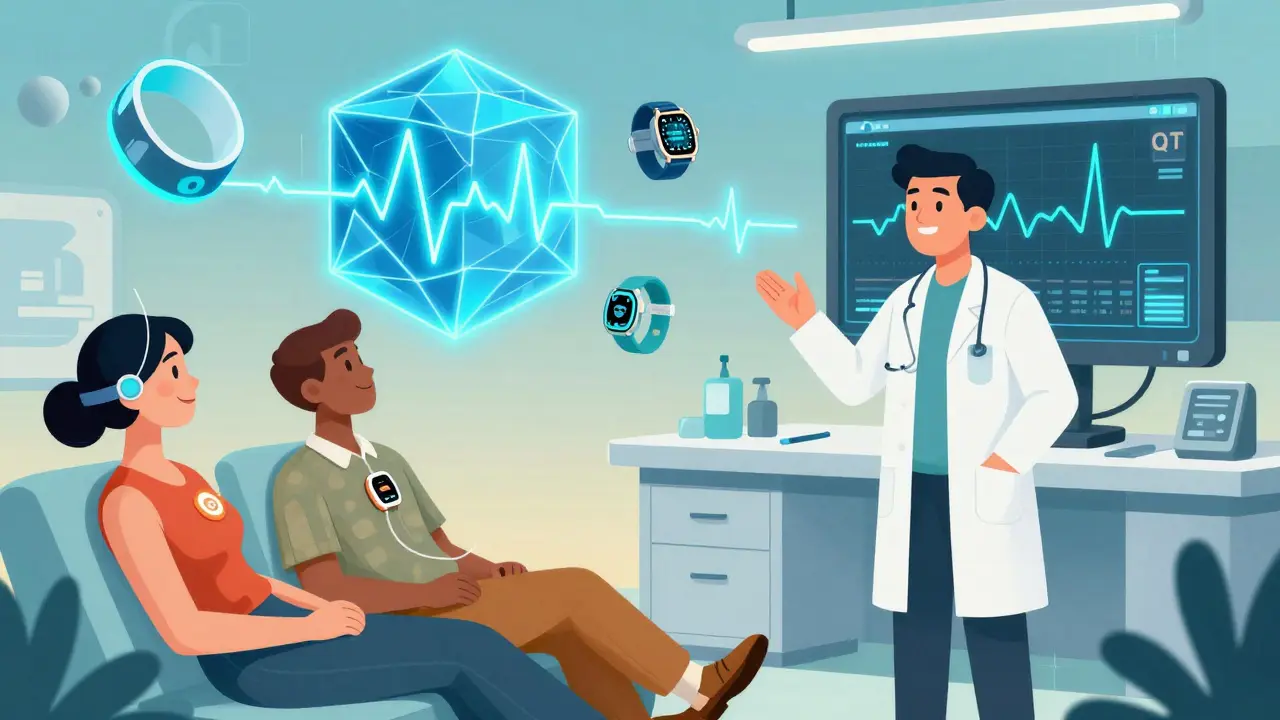
By 2027, expect wearable ECGs to be standard in outpatient cardiac safety programs. New devices are coming - smart rings, chest patches, even shirts with built-in sensors. AI will automate alerts. Some hospitals are already testing systems that send real-time QT data to electronic health records.
The goal isn’t to replace doctors. It’s to give them better data - faster. To catch danger before it becomes an emergency. To let patients live normally, while their heart is quietly watched.
This isn’t science fiction. It’s happening now. And for people who need it, it’s already saving lives.
Can I rely on my Apple Watch to detect dangerous QT prolongation?
The Apple Watch can reliably measure QT intervals in most cases, especially when used correctly and repeatedly. Studies show its readings correlate strongly with hospital ECGs. But it doesn’t automatically warn you if your QT is dangerous. You need to review the numbers with your doctor. Don’t use it as a standalone diagnostic tool - use it as a tracking tool.
Is the KardiaMobile 6L better than the Apple Watch for QT monitoring?
Yes, for clinical accuracy. The KardiaMobile 6L records a 6-lead ECG, which gives more data than the Apple Watch’s single lead. This means better precision in QT measurement and fewer false readings. If you’re on high-risk medication or have a known heart condition, KardiaMobile 6L is the preferred device. But if you want convenience and daily checks, the Apple Watch is still very effective.
Do I need a prescription to use a wearable ECG for QT monitoring?
No, you don’t need a prescription to buy these devices. Both the Apple Watch and KardiaMobile 6L are available over the counter. But to use them for medical monitoring - especially if you’re on QT-prolonging drugs - you should discuss it with your doctor. They can help you interpret results and decide if you need a formal ECG or medication adjustment.
Can these devices detect heart attacks or other heart problems?
No. These devices are optimized for detecting atrial fibrillation and QT prolongation. They’re not designed to spot heart attacks, heart failure, or blocked arteries. If you have chest pain, shortness of breath, or dizziness, don’t wait for your device to respond. Call emergency services immediately.
Are there any privacy or data security risks with these devices?
Yes. ECG data is sensitive health information. Apple and AliveCor encrypt data and comply with HIPAA in the U.S., but you should still check the app’s privacy settings. Avoid sharing your ECG PDFs publicly. If you’re using the device in a clinical trial, confirm how your data is stored and who has access. Always use strong passwords and two-factor authentication on your phone.
How often should I check my QT interval with a wearable device?
It depends on your risk level. If you’re starting a new QT-prolonging drug, check daily for the first week, then every other day for the next two weeks. After that, once or twice a week is usually enough unless your doctor says otherwise. If your QTc is stable for a month, your doctor may reduce monitoring frequency. Always follow your provider’s guidance - not the app’s default settings.


Write a comment