
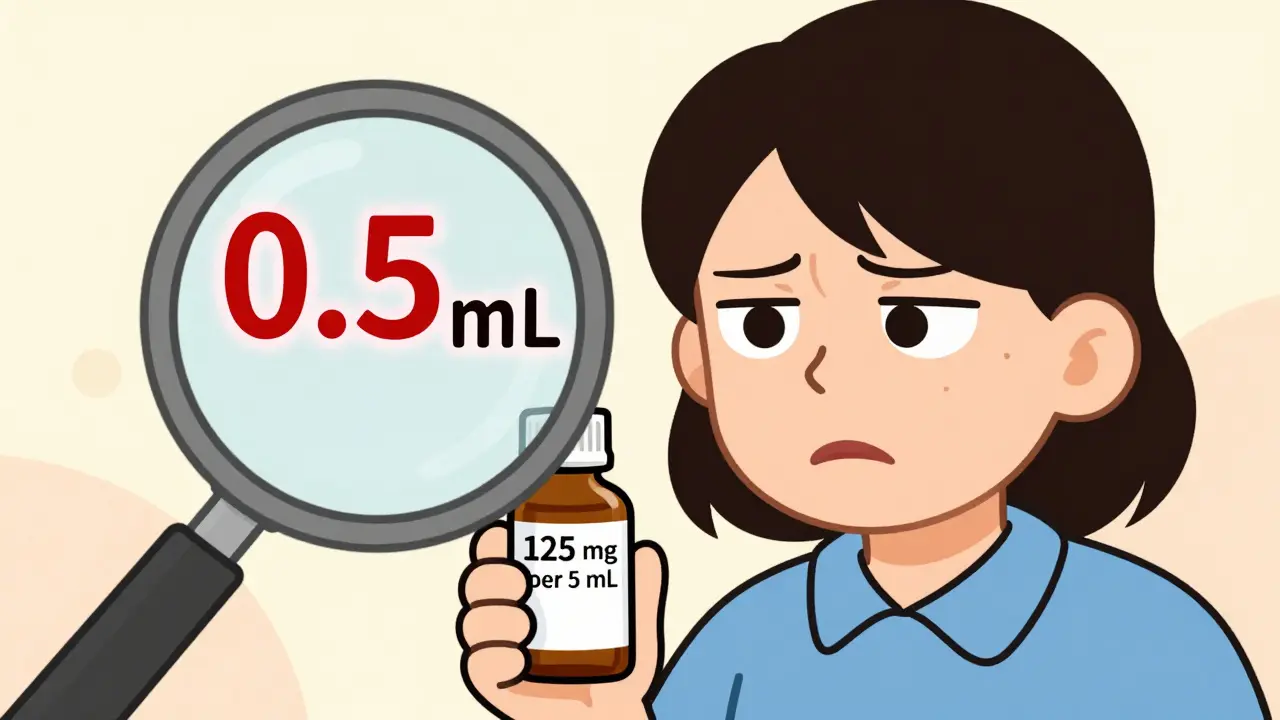
Getting the right dose of liquid medicine isn’t just about following instructions-it’s about survival. A single mistake in reading a prescription label can mean the difference between healing and harm. In the U.S. alone, over 1.3 million injuries each year come from errors in liquid medication dosing, according to the FDA. Most of these mistakes happen because people misread the numbers on the label. You’re not alone if you’ve stared at a bottle thinking, Is that 0.5 mL or 5 mL? or Why does it say 240 mg per 5 mL? This guide cuts through the confusion and shows you exactly how to read those tiny print lines so you give the right amount every time.
Understand the Three Key Parts of the Label
Every liquid prescription label has three critical pieces of information you need to spot immediately: concentration, dosage amount, and total volume. These aren’t just random details-they’re the foundation of safe dosing.
Concentration tells you how much medicine is in each unit of liquid. You’ll see it written like this: 125 mg per 5 mL. That means every 5 milliliters of liquid contains 125 milligrams of the active drug. If your doctor prescribed 62.5 mg, you don’t take half the bottle-you take half of 5 mL, which is 2.5 mL. Confusing concentration with total dose is the most common mistake. Don’t assume the number on the bottle is your dose. Always look for the “per” word.
Dosage amount is what you’re supposed to take. It’s usually written as “Take 10 mL twice daily.” This is your actual dose. It’s not the concentration. It’s not the total volume in the bottle. It’s the number of milliliters you pour into the measuring device. If the label says “Take 5 mL,” then you measure 5 mL-no more, no less.
Total volume is how much liquid is in the whole bottle. You might see “118 mL” or “240 mL” printed on the side. This tells you how long the bottle will last, not how much to take. A bottle labeled 118 mL with a dose of 10 mL twice daily will last about six days. Don’t confuse this number with your dose. Mixing them up is how people end up giving too much-or running out too soon.
Milliliters Only-No Teaspoons or Tablespoons
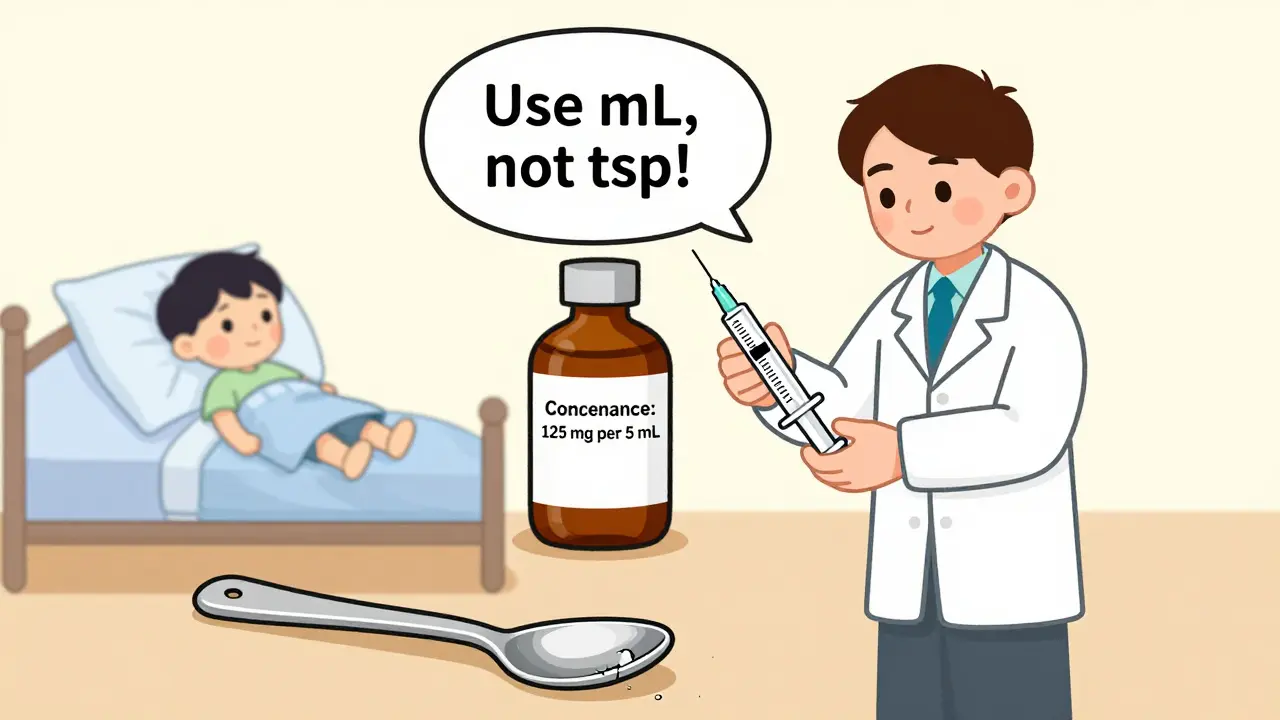
Look closely at the label. If you see “tsp” or “tbsp,” it’s outdated. The FDA and the National Council for Prescription Drug Programs (NCPDP) have required pharmacies to use milliliters (mL) only since 2016. Why? Because household spoons are wildly unreliable. A teaspoon can hold anywhere from 2.5 mL to 7.5 mL. A tablespoon? It could be 5 mL or 20 mL. That’s a 300% variation. One study found parents using spoons were twice as likely to give the wrong dose compared to those using mL-measured devices.
Even if your doctor says “half a teaspoon,” the pharmacy label must convert that to 2.5 mL. Never rely on kitchen spoons. Even if the label has both mL and tsp markings, use the mL side. The teaspoon markings are there for reference only, not for measuring.
Some labels still show both, especially older ones or those from small pharmacies. If you see “5 mL (1 tsp),” treat the mL as the official number. Ignore the tsp part unless you’re using a device that only shows teaspoons-and even then, only if you’re certain it’s calibrated. Most over-the-counter syringes and cups now have mL markings as the primary scale. Always go with mL.
Decimal Points Can Kill
Look at this: 0.5 mL. Now look at this: .5 mL. They mean the same thing-but one is dangerously wrong. The FDA requires that doses under 1 mL must always include a leading zero: 0.5 mL, not .5 mL. Why? Because if the zero is missing, someone might read “.5 mL” as “5 mL.” That’s a tenfold overdose. In a 2018 Johns Hopkins study, fixing this one rule cut dosing errors by 47%.
The same rule applies in reverse: never write or read 5.0 mL. That trailing zero suggests precision that doesn’t exist in most liquid medications. It can make someone think they need to measure exactly 5.0, when 5 mL is the target. Just “5 mL” is correct. No extra zeros. No decimals unless the number is less than one.
Check every number on the label. If you see “.3 mL” or “2.0 mL,” ask the pharmacist to confirm. They’re supposed to fix those errors before giving you the bottle. If they don’t, say so. It’s your safety.
Use the Right Measuring Tool
The bottle might come with a plastic cup, a syringe, or a dosing spoon. Don’t use any of them unless they’re marked in mL and match the dose on the label. Many dosing cups have both mL and tsp markings. Use the mL side. If the cup says “5 mL” but the dose is 2.5 mL, make sure the line for 2.5 mL is clearly visible. If it’s not, ask for a syringe.
Oral syringes are the gold standard. They’re accurate, easy to read, and hard to mess up. A 5 mL syringe with clear markings for every 0.1 mL is ideal for children and seniors. You can buy them at any pharmacy for under $2. Don’t wait for the pharmacy to give you one. Ask for it. If they say they don’t have one, ask for a different one. Many pharmacies keep them behind the counter.
Never use a kitchen spoon, a shot glass, or a medicine dropper unless it’s clearly marked in mL. Even if it says “1 tsp” on the side, trust the mL number. And always measure at eye level. Tilting the cup or syringe changes the reading. Hold it up to your eyes. Make sure the liquid’s meniscus (the curve at the top) lines up exactly with the line.
Check the Concentration Every Time
Here’s a real-life trap: You’ve given your child the same medicine before. Last time, it was 160 mg per 5 mL. This time, it’s 125 mg per 5 mL. Same brand. Same color. Same bottle shape. But the dose is different. If you give the same 5 mL, you’re giving 35 mg less. That might not seem like much-but for a child, it can mean the medicine doesn’t work.
Always check the concentration on the label before each dose. Don’t assume it’s the same. Different batches, different manufacturers, even different pharmacies can have different strengths. The label will always say “___ mg per ___ mL.” Memorize that number. Write it down if you need to. Compare it to the last bottle you used.
One parent on Reddit said: “I gave my baby 5 mL of fever medicine because I thought it was the same as last time. Turned out the new bottle was half the strength. He still had a fever for two days.” That’s preventable. Always check.
Ask for a Demonstration
Pharmacists are trained to help you read labels. But they won’t always offer. If you’re unsure, say: “Can you show me how to measure this dose?”
Studies show that when pharmacists demonstrate the dose using the actual measuring device, patient errors drop from 39.4% to just 22%. That’s a 44% improvement. Even better: if you’re asked to show them how you’d measure it-what’s called the “teach-back” method-errors drop by 63%. You’re not being tested. You’re being protected.
Don’t feel embarrassed. One in three adults in the U.S. has trouble understanding health information, according to the National Assessment of Adult Literacy. That’s not about intelligence. It’s about design. Labels are confusing. Systems are outdated. Asking for help isn’t weakness-it’s smart.
What If the Label Is Still Confusing?
If you’re still unsure, call the pharmacy back. Read the label to them. Say: “I’m supposed to give 0.8 mL, but the syringe only has lines for 0.5 and 1.0. What do I do?” They’ll tell you. Or they’ll give you a different syringe.
If the label doesn’t have the concentration clearly marked, or if it says “tsp,” or if the numbers look smudged-don’t guess. Go back. Ask for a new label. Refuse to take it home until it’s clear. Pharmacies are required by law to provide accurate labeling. If they don’t, report it to your state’s board of pharmacy.
Also, check the expiration date. Liquid medicines lose potency over time. If it’s expired, don’t use it-even if it looks fine. The active ingredients can break down. What’s left might not work-or could even be harmful.
What’s New in 2026?
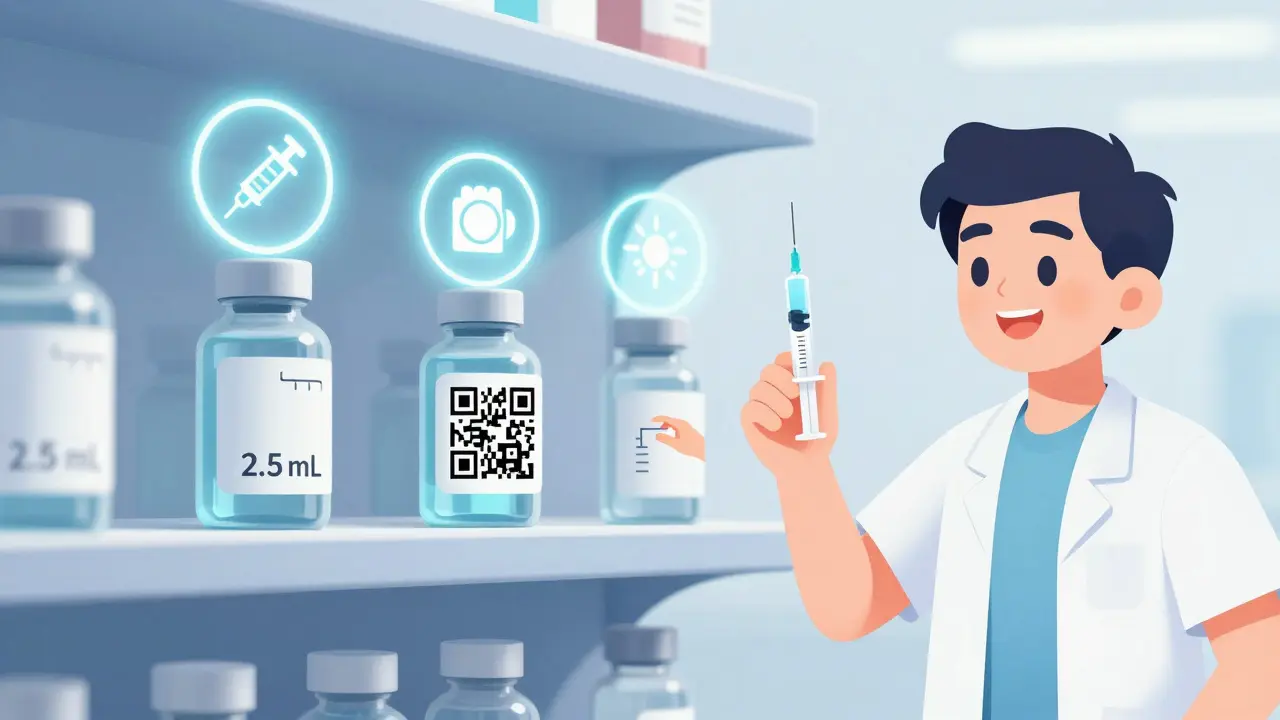
By 2026, nearly all pharmacies in the U.S. and Canada will be required to use pictograms on liquid medication labels. These are simple icons showing how to measure the dose-like a syringe with a line at 2.5 mL. A 2022 study found these pictograms reduced errors by 37%.
Some pharmacies now include QR codes on labels. Scan it with your phone and you’ll see a short video showing exactly how to measure the dose. Amazon Pharmacy and McKesson’s Medly already use this. More will follow.
And starting in 2025, Medicare Part D will penalize pharmacies with high rates of dosing errors. That means pharmacies are now more motivated than ever to get it right. But you still have to check. No system is perfect. Your eyes are the final safety net.
Final Checklist Before You Give the Dose
- Is the dose written in mL only? (No tsp or tbsp)
- Does the number under 1 have a leading zero? (0.5 mL, not .5 mL)
- Is the concentration clearly stated? (e.g., 125 mg per 5 mL)
- Are you measuring the dosage amount, not the total volume?
- Are you using a device marked in mL?
- Are you reading the measurement at eye level?
- Did you compare this bottle’s concentration to the last one?
- Did you ask the pharmacist to show you how to measure it?
If you answered yes to all eight, you’re safe. If even one is no, stop. Call the pharmacy. Don’t risk it.


Write a comment